What Happened to Tim Holt, Western Star?
The Son of a Silent Star
Tim Holt was born Charles John Holt III on February 5, 1919, in Beverly Hills, California, the son of Jack Holt, a major star of silent films and early talkies, and Margaret Woods, and the boy grew up inside the movie business, with a father who was a household name and a household that ran on studio schedules. His younger sister, Jennifer Holt, would follow him into westerns, and the two of them were the rare brother-and-sister act of the B-movie world, although they never appeared together in a single film. Tim attended military school as a teenager, where he excelled at polo, and then went on to the University of Southern California, where he met his college sweetheart, Virginia Ashcroft, and married her in December 1938, eloping while still a student. The marriage produced a son, Lance, born in 1940, and ended in divorce in 1944.
Hollywood found him early, as it usually found the children of stars, and his first screen appearances came while he was still a young man finding his footing. He had small parts in the early 1940s, including a role in Orson Welles's The Magnificent Ambersons, and the work was steady enough to suggest a career, but not yet the career that would define him. The defining thing was the western, and the western found him when RKO Pictures began building him into a cowboy star, a clean-cut, athletic leading man who could ride, fight and look honest doing it. Some sources, including IMDb, give his birth year as 1918 rather than 1919; this article follows Wikipedia, which gives February 5, 1919.
Forty-Six Westerns for RKO
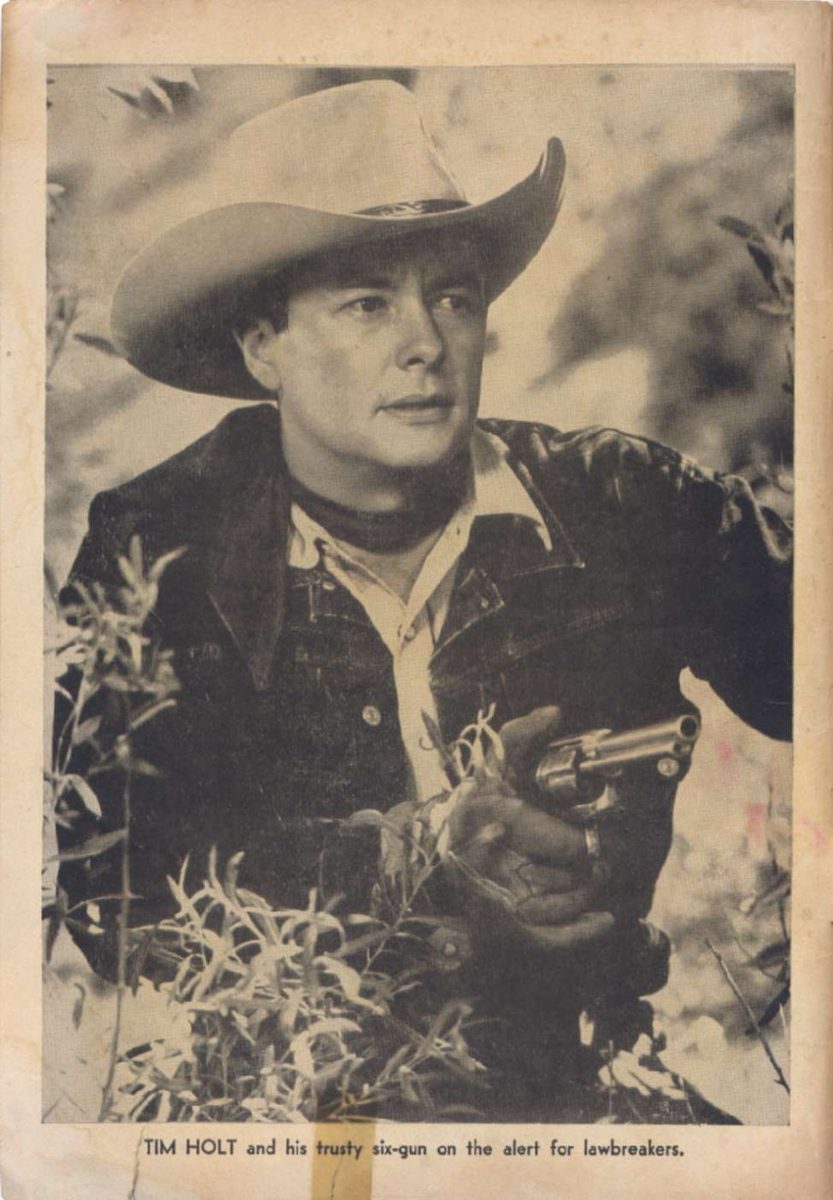
Holt's run as a western star was one of the most productive in the history of the B-movie, because between the early 1940s and 1952 he starred in 46 westerns released by RKO Pictures, a pace of roughly four or five pictures a year, each one shot fast, cheap and cheerful, and each one putting his name above the title for an audience that came back week after week. The films had titles like The Fargo Kid, Wagon Train, The Bandit Trail and Desert Passage, and the formula rarely changed: Holt played the decent young cowboy, often alongside his comic sidekick, and the villains were rustlers, claim jumpers and crooked land barons. The work was not prestigious, and the critics mostly ignored it, but the box office did not, and Holt became one of the most reliable draws in the Saturday matinee trade.
The westerns made him a star, but they also made him a type, and the type was hard to escape, because the studios saw a cowboy and kept him a cowboy, and the audience expected the hat and the horse and got them. Holt accepted the bargain for a decade, and the bargain paid, because the pictures kept coming and the money was good, and the fame, such as it was, was real in the small towns where the RKO westerns played. But the bargain had a cost, and the cost was that when the B-western died, as it did in the early 1950s when television took its audience, Holt had nowhere obvious to go, and the going was the story of the rest of his life.
The Treasure of the Sierra Madre
The one film that lifted Holt out of the B-western ghetto, and the one that film lovers still remember him for, was The Treasure of the Sierra Madre, John Huston's 1948 classic, in which Holt played Curtin, the younger of the two American prospectors who follow Humphrey Bogart's Fred C. Dobbs into the Mexican mountains in search of gold. It was a serious dramatic role in an A-picture, opposite one of the biggest stars in the world, and Holt held his own, playing Curtin as decent, loyal and quietly brave, the moral counterweight to Bogart's paranoid, gold-crazed Dobbs. The film won Academy Awards and became one of the most admired American films ever made, and Holt's performance in it is the proof that he could do more than ride and shoot.
The irony of Sierra Madre is that it did not change his career, because after it he went straight back to the RKO westerns, and the westerns kept coming until the unit was shut down. Desert Passage, released in 1952, was the last of his RKO westerns, and it closed the book on the phase of his life that had made him famous. He was still a popular draw when he walked away, and the walking away was his choice, because he had grown disillusioned with the quality of the pictures and with Hollywood itself, and he wanted a different life, and the different life was in Oklahoma, where he had been before, and where he would stay.
A Decorated Bomber Pilot
Before the peak of his western fame there was the war, and the war was real, because Holt entered the United States Army Air Corps during the Second World War and became a B-29 bombardier, flying missions over the Pacific, and the flying was dangerous work, and the danger was not a movie. He was wounded over Tokyo on the last day of the war, and he was awarded the Purple Heart for it, along with the Distinguished Flying Cross, the Victory Medal and the Presidential Unit Citation, and he was discharged with the rank of second lieutenant. The decorations were not publicity; they were earned in a bomber over the Pacific, and they say more about the man than any of his film roles did.
The war interrupted his career for more than three years, at exactly the moment when it was taking off, and the interruption could have ended it, because western stars were replaceable and audiences were fickle, but Holt came home to a bigger career than the one he had left, and the bigger career was the RKO westerns at their peak. The war also changed him, in the way that wars change men, and the change showed in the way he talked about Hollywood afterwards, with less patience for its vanities, and in the way he eventually left it, without regret, for a ranch in Oklahoma and a life that had nothing to do with cameras.
Oklahoma, Radio and a Quiet Retirement
Holt had first been to Oklahoma in 1947 with a rodeo, and it was there that he met Berdee Stephens, the woman who would become his third wife, after his second marriage, to Alice Harrison, ended in divorce in 1952. He married Berdee on September 4, 1952, and the marriage lasted until his death, and the couple settled on a ranch near Harrah, Oklahoma, with their three children, Bryanna, Jay and Jack, joining Holt's son Lance from his first marriage to make four children in all. He worked for a time in the cattle feed business, and then went into radio, becoming the manager of a radio station in Oklahoma City, and the radio work was steady, honest employment, far from the studios, and it suited him.
He did not vanish entirely, because he came out of retirement three times for films that caught his interest, or his fancy: the science-fiction picture The Monster That Challenged the World in 1957, the low-budget The Yesterday Machine in 1963, and the backwoods crime picture This Stuff'll Kill Ya! in 1971, directed by Herschell Gordon Lewis. He also did personal appearance tours and a few television appearances, but the tours and the appearances were the exception, and the rule was the ranch, the radio station and the family, and the family was the point, because Holt had chosen it over Hollywood, and the choosing was final.
Three Marriages and Four Children
Holt was married three times, and the three marriages map the three phases of his life, because the first, to Virginia Ashcroft, was the college marriage, begun in December 1938 when he was nineteen and she was his sweetheart at USC, and it produced his eldest son, Lance, and ended in divorce in June 1944. The second, to Alice Harrison, began later in 1944 and ended in divorce in 1952, and it was the Hollywood marriage, lived through the peak of his western fame. The third, to Berdee Stephens, began in September 1952 and lasted until his death more than twenty years later, and it was the Oklahoma marriage, lived on the ranch and in the radio station, and it produced three children, Bryanna, Jay and Jack.
The family stayed close after his death, and his widow Berdee lived on in Harrah, Oklahoma, until 2011, and the children kept his memory alive in the town where he had chosen to live. The town returned the affection, because the street where he and Berdee had lived was renamed Tim Holt Drive in his honor, and the renaming was the kind of tribute that a B-western star could understand, a street in a small Oklahoma town, named for a man who had ridden across a thousand movie screens and then come home to live among the people who had watched him do it.
What Happened to Tim Holt, in the End
So what happened to Tim Holt? He was born Charles John Holt III in Beverly Hills in 1919, the son of the silent star Jack Holt, and he married his college sweetheart Virginia Ashcroft in 1938, and he became a western star for RKO, making 46 B-westerns in the 1940s and early 1950s, and he flew as a B-29 bombardier in the Second World War, winning the Distinguished Flying Cross and the Purple Heart, and he co-starred with Humphrey Bogart in The Treasure of the Sierra Madre in 1948, and he left Hollywood after Desert Passage in 1952, and he married Berdee Stephens and settled on a ranch in Oklahoma, and he managed a radio station in Oklahoma City, and he made three more films, the last of them in 1971, and he was diagnosed with bone cancer in August 1972.
He died on February 15, 1973, at 54, in Shawnee, Oklahoma, just ten days after his 54th birthday, and he was buried in Memory Lane Cemetery in Harrah, Oklahoma, and in 1991 he was inducted posthumously into the Hall of Great Western Performers at the National Cowboy and Western Heritage Museum in Oklahoma City, and in 1992 he received the Golden Boot award, and the street in Harrah where he had lived with Berdee was named Tim Holt Drive, and he is, still, the clean-cut cowboy of the RKO westerns, and the co-star of Bogart in Sierra Madre, and the bomber pilot who came home and chose Oklahoma over Hollywood, and who died, in the end, at 54, in Shawnee, and who is, in the end, remembered every time a Saturday matinee western plays, and every time the gold, in the end, is found.
Frequently asked questions
What happened to Tim Holt?
Tim Holt died at 54 in Shawnee, Oklahoma, of bone cancer, after a career as one of the most popular B-western stars of the 1940s. He had left Hollywood years earlier to live on a ranch in Oklahoma and manage a radio station.
Who was Tim Holt's father?
The silent-film star Jack Holt. Tim's younger sister, Jennifer Holt, also acted in B-westerns, though the brother and sister never appeared together in a single film.
What was Tim Holt's most famous film?
The Treasure of the Sierra Madre, in which he played Curtin opposite Humphrey Bogart. He also starred in 46 westerns for RKO Pictures, ending with Desert Passage.
Did Tim Holt serve in the war?
Yes, as a B-29 bombardier in the Army Air Corps. He was wounded over Tokyo on the last day of the war and received the Purple Heart and the Distinguished Flying Cross.
Why did Tim Holt leave Hollywood?
He had grown disillusioned with the quality of his westerns and with Hollywood itself. After his last RKO western he settled in Oklahoma, worked in the cattle feed business and then managed a radio station.
Who was Tim Holt married to?
Three times: Virginia Ashcroft, his college sweetheart, then Alice Harrison, and finally Berdee Stephens, whom he married in Oklahoma and stayed with until his death.
How many children did Tim Holt have?
Four: a son, Lance, from his first marriage, and three children, Bryanna, Jay and Jack, from his third marriage.
Where is Tim Holt buried?
In Memory Lane Cemetery in Harrah, Oklahoma. The street where he lived with his third wife was renamed Tim Holt Drive in his honor, and he was inducted into the Western Performers Hall of Fame after his death.
Sources
- EN WikipediaBirth February 5 1919, Jack Holt's son, 46 RKO westerns, Army Air Corps service, three marriages, bone cancer death February 15 1973
- Brian's Drive-In TheaterBeverly Hills birth, B-29 bombardier, Purple Heart, Desert Passage last RKO western, Oklahoma radio station, death February 15 1973
- IMDbBirth year 1918 variant, USC and Virginia Ashcroft marriage, Alice Harrison and Berdee Stephens marriages, four children