What Happened to Shelley Duvall?
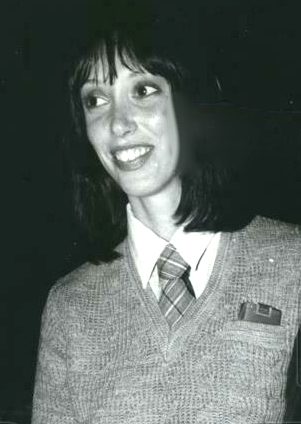
Discovered by Accident in Houston
Shelley Alexis Duvall was born on July 7, 1949, in Fort Worth, Texas, and grew up around Houston, the daughter of a cattle auctioneer turned lawyer and a real estate broker. She was attending junior college and had no plans to act when, in 1970, she threw a party to sell her husband's artwork and members of Robert Altman's film crew, who were in Houston shooting Brewster McCloud, happened to attend. Taken with her unusual looks and manner, they introduced her to Altman, who cast her on the spot as the love interest of Bud Cort's title character, despite her complete lack of training. She said yes, and a career began by accident.
Altman became her mentor, and she became a core member of his repertory company throughout the 1970s. She appeared in McCabe & Mrs. Miller (1971) as a sweet-natured young widow who turns to prostitution, Thieves Like Us (1974), Nashville (1975) as a kooky Californian in the vast ensemble, Buffalo Bill and the Indians (1976), and 3 Women (1977), in which she gave a largely improvised performance that won her Best Actress at the Cannes Film Festival and a BAFTA nomination. Critic Pauline Kael called her the female Buster Keaton, praising her understated physicality, and fans called her the Texas Twiggy. She was, as Altman himself said, able to swing all sides of the pendulum: charming, silly, sophisticated, pathetic, even beautiful.
Popeye, Annie Hall, and The Shining
By the end of the 1970s Duvall was working beyond Altman as well. She had a memorable cameo as a rock journalist in Woody Allen's Annie Hall (1977), played Pansy in Terry Gilliam's Time Bandits (1981), and starred opposite Steve Martin in Roxanne (1987). In 1980 she reunited with Altman to play Olive Oyl opposite Robin Williams in the live-action musical Popeye, a role Roger Ebert said she was born to play, complete with the unforgettable musical number He's Large. She also hosted Saturday Night Live in 1977 and dated Paul Simon and Ringo Starr, becoming, for a time, one of the most photographed women in America.
But the role that defined her for most audiences was Wendy Torrance in Stanley Kubrick's The Shining (1980), opposite Jack Nicholson as a writer descending into madness in the isolated Overlook Hotel. The shoot was notoriously grueling: Kubrick demanded take after take, and Duvall spent months in a state of manufactured terror, crying for hours at a time. She told People in 1981 that the thirteen-month job was grueling, that Kubrick had her crying twelve hours a day for weeks on end, and that she would never give that much to a role again. The performance, once criticized as overbearing, has since been re-evaluated as one of horror's great portrayals of a woman fighting for her child, and Duvall's screaming face, half of the film's most iconic image alongside Nicholson's axe through a door, is now part of film history.
A Second Career in Children's Television
In the 1980s Duvall reinvented herself as a producer of children's television, and this second career may be her most lasting achievement. She created and hosted Faerie Tale Theatre, which ran from 1982 to 1987 and featured major stars retelling classic fairy tales, followed by Disney Channel's Mother Goose Rock 'n' Rhyme, Tall Tales & Legends, and Shelley Duvall's Bedtime Stories. The shows were imaginative, literate, and star-studded, and they earned her two Primetime Emmy nominations, in 1988 and 1992, along with a shelf of other honors for children's programming. She was not just a former actress lending her name to a project. She was the creative force behind it, a writer, producer, and host who understood what children actually liked.
It was on Mother Goose Rock 'n' Rhyme that she met Dan Gilroy, a musician who had played in the band Breakfast Club. They became partners, and they would remain together for more than thirty years, until her death. Gilroy later said that their life in Los Angeles was really terrific, until the 1994 Northridge earthquake damaged Duvall's home and, after her brothers fell ill, the couple moved to Texas. The move marked the beginning of her long retreat from public life, and for the next two decades she lived quietly, first in Los Angeles and then in Blanco, Texas, far from the industry that had made her famous.
The Long Retreat and the Difficult Years
Duvall's last film before her long break was Manna from Heaven (2002), and after that she retired from acting. In the years that followed, her health declined, and she became increasingly reclusive. She gave a much-criticized television interview in 2016 in which she discussed her mental health in terms that alarmed viewers and drew widespread criticism of the program for exploiting her. This article does not repeat the contents of that interview, which Duvall's partner and others later described as a distressing episode, but it is part of the public record that the interview damaged her public image and deepened her withdrawal. She also lived with diabetes and limited mobility from a foot injury, and she spent much of her later life in her home in Blanco, often sitting in the front seat of her white Toyota 4Runner, where she felt most comfortable.
What is often lost in accounts of those years is that Duvall was not alone, and not unhappy in any simple sense. Friends, including artist Ryan Obermeyer and others in her Texas circle, helped her recover lost personal effects, reconnected her with old friends including Paul Reubens, and celebrated her seventieth birthday with her. She was, by those accounts, living a full life on her Texas ranch, with Gilroy, their many pets, and a growing circle of friends, even as her health limited her. The image of a forgotten star, alone and abandoned, is not the whole story, and the people closest to her have said so plainly.
The New York Times Profile and a Final Role
In April 2024 Duvall gave a rare, lengthy interview to the New York Times, her first major profile in years, accompanied by portraits of her in Blanco. In it she spoke with striking clarity about her career and about feeling betrayed by an industry that had once celebrated her. I was a star, she said. I had leading roles. People think it's just aging, but it's not. It's violence. How would you feel if people were really nice, and then, suddenly, on a dime, she snapped her fingers, they turn on you? You would never believe it unless it happens to you. That's why you get hurt, because you can't really believe it's true. Gilroy spoke alongside her, describing the life they had built and the health problems she faced, including diabetes and a foot injury that affected her mobility.
The profile also revealed that Duvall had returned to acting. After a twenty-year break, she had taken a small role in the independent horror film The Forest Hills, directed by Scott Goldberg, playing the mother of the central character, heard as his inner voice. I wanted to act again, she told the Times, and then this guy kept calling, and so I wound up doing it. Goldberg said watching her perform again was as if time never passed, and Duvall herself said it was great fun being back, that she loved the work, and that it could really help bring you out of a slump. The film was released digitally in October 2024, three months after her death, and it stands as her final performance.
Her Death and Her Legacy
Shelley Duvall died in her sleep at home in Blanco, Texas, on July 11, 2024, at the age of 75, of complications from diabetes. Her partner, Dan Gilroy, announced her death to the Hollywood Reporter, saying: My dear, sweet, wonderful life partner and friend left us. Too much suffering lately, now she's free. Fly away, beautiful Shelley. She had been in hospice care for several months, and she died a little after midnight, just days after her seventy-fifth birthday celebrations. She was survived by Gilroy and by her three younger brothers, Scott, Stewart, and Shane.
The tributes that followed remembered all of her careers at once: the Altman muse, the horror heroine, the children's television pioneer, and the woman who had survived one of the hardest shoots in film history and then built a life on her own terms. Her work continues to find new audiences, from The Shining, which never leaves the cultural conversation, to Faerie Tale Theatre, which parents now show their own children. She never set out to be an actress, and she never took herself too seriously, advice Altman gave her at the very beginning. That lightness, that refusal to be ordinary, is what made her unforgettable.
Why Shelley Duvall Still Matters
It is easy to remember Shelley Duvall only for The Shining, or only for the difficult final years that the tabloids preferred to cover. Both memories are incomplete. Her real legacy is broader and stranger: seven films with one of America's greatest directors, a Cannes Best Actress award, a horror performance that redefined what a final girl could be, and a children's television empire built from scratch by a woman who had never planned to act at all. She was, as Kael saw, a singular screen presence, and there has never been another quite like her.
What happened to Shelley Duvall, in the end, is that she lived a long, complicated, creative life, left Hollywood when it stopped being kind to her, found love and a home in Texas, and came back, once, at the very end, to do the thing she loved, because someone kept calling and she wanted to act again. She died at home, with her partner nearby, after a life that was, by any measure, extraordinary. Fly away, beautiful Shelley, Gilroy said, and millions of fans, who had loved her since Brewster McCloud, since Nashville, since The Shining, said it with him.
Frequently asked questions
What happened to Shelley Duvall?
Shelley Duvall died in her sleep at home in Blanco, Texas, on July 11, 2024, at age 75, of complications from diabetes, after several months in hospice care. Her final film role was in The Forest Hills, released digitally in October 2024.
What was Shelley Duvall famous for?
She was Robert Altman's muse, starring in seven of his films including Nashville and 3 Women, for which she won Best Actress at Cannes in 1977. She is best known to most audiences as Wendy Torrance in The Shining (1980) and as Olive Oyl in Popeye (1980).
What was Shelley Duvall's last movie?
Her last film was The Forest Hills, an independent horror film in which she played the mother of the central character. It was filmed at her home after a twenty-year break from acting and released digitally in October 2024, after her death.
Why did Shelley Duvall leave Hollywood?
She retired from film acting after Manna from Heaven (2002) and moved to Texas with her partner Dan Gilroy after the 1994 Northridge earthquake damaged her Los Angeles home. She also built a children's television producing career in the 1980s before retreating from public life.
Who was Shelley Duvall's partner?
Her longtime partner was musician Dan Gilroy, whom she met on Mother Goose Rock 'n' Rhyme around 1990. They were together for more than thirty years until her death in 2024.
Was Shelley Duvall related to Robert Duvall?
No. Despite sharing a surname, Shelley Duvall was not related to actor Robert Duvall.
What children's shows did Shelley Duvall make?
She created and hosted Faerie Tale Theatre (1982-1987), Mother Goose Rock 'n' Rhyme, Tall Tales & Legends, and Shelley Duvall's Bedtime Stories, earning two Primetime Emmy nominations.
How did Shelley Duvall die?
She died of complications from diabetes, in her sleep at home in Blanco, Texas, on July 11, 2024, at age 75, after several months in hospice care, according to her partner Dan Gilroy.
Sources
- EN WikipediaBiography, Altman films, Cannes award, Shining, death
- New York Women in Film & TelevisionObituary, Altman career, children's television, Forest Hills
- Entertainment TonightDeath at 75, diabetes complications, 2002 retirement, 2024 interview
- LooperTexas life, Forest Hills return, Gilroy account