What Happened to Russell Johnson, Professor?
A Boarding School Boy from Ashley, Pennsylvania
Russell David Johnson was born on November 10, 1924, in Ashley, Pennsylvania, the eldest of seven children, and his childhood was marked, early, by loss: his father died when Johnson was eight, and he was sent to Girard College, a boarding school in Philadelphia for fatherless boys, where he grew up among other boys who had lost a parent and where he learned, as he later said, self-reliance. Girard was not a soft place, but it was, for Johnson, a formative one, and he left it with a discipline and a seriousness that would serve him, first in war and then in acting. He was, by his own account, not a natural performer as a boy, but he was a reader, a thinker and a young man who understood, from an early age, that life could change in an instant, a lesson the war would teach him again, more brutally.
Johnson enlisted in the United States Army Air Forces during World War II, and he served as a bombardier and navigator on B-25 Mitchell bombers in the Pacific, flying 44 combat missions, a number that, by the standards of the Pacific air war, represented extraordinary exposure to danger. He was awarded the Purple Heart, the Air Medal, the Asiatic-Pacific Campaign Medal, the Philippine Liberation Ribbon and the World War II Victory Medal, decorations that testify to a service record of real distinction, and he was honorably discharged as a first lieutenant on November 22, 1945. The war, for Johnson, was not an abstraction or a story he told at parties. It was the central experience of his young manhood, and it shaped the serious, disciplined man he became.
Shot Down Over the Philippines
On March 4, 1945, Johnson's B-25, with the 100th Bombardment Squadron, 42nd Bombardment Group, 13th Air Force, was shot down during a low-level bombing run against Japanese targets in the Philippine Islands, along with two other bombers in the formation. The plane ditched in the sea off Zamboanga, and Johnson broke both ankles in the crash, an injury that could easily have killed him and that, in the water, with a war still going on around him, must have seemed, for a time, like a death sentence. The bomber's co-pilot was killed in the crash, and Johnson, with both ankles broken, survived, was rescued, and recovered, carrying, for the rest of his life, the memory of a morning when his plane fell out of the sky and his co-pilot did not come home. He rarely spoke about the crash in detail, but when he did, he spoke of it plainly, without self-pity, as a man who had survived something that others had not.
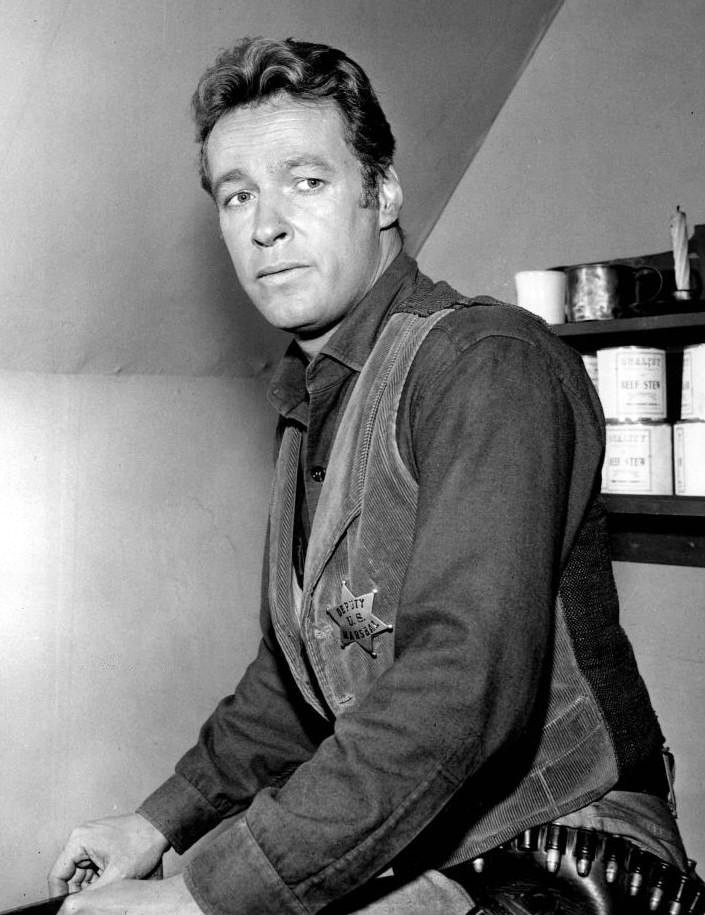
After the war, Johnson used the GI Bill to study acting at the Actors Lab in Hollywood, a decision that, to a man who had flown 44 combat missions, must have seemed both improbable and inevitable, and he signed a contract with Universal Studios, beginning a film career in the early 1950s. He appeared in science-fiction films that became cult classics, including It Came From Outer Space in 1953, in which he played a scientist, and This Island Earth in 1955, in which he played a scientist again, a type he would play, with variations, for much of his career. He was, by the late 1950s, a reliable character actor, a man who could play a scientist, a soldier or a lawman with equal conviction, and he was, in 1960, cast as Marshal Gib Scott on the Western series Black Saddle, a role that gave him his first sustained television fame and that, in a publicity portrait from that year, shows him as a lean, serious lawman, a long way from the Professor he would become.
Marshal Gib Scott and the Road to Gilligan
Black Saddle ran from 1959 to 1960, and Johnson played Marshal Gib Scott, a lawman in a Western town, with the same seriousness he had brought to his film roles, and the show gave him a taste of series television, of playing the same character week after week, of becoming familiar to an audience. After Black Saddle, Johnson worked in television Westerns and dramas, building a resume of guest roles and recurring parts, and he was, by 1964, a working actor in his late thirties, respected but not famous, when he was offered a role on a new sitcom about seven castaways stranded on a desert island. The role was Professor Roy Hinkley, a high-school science teacher and brilliant inventor who, with a few coconuts and some bamboo, could build almost anything except a way off the island, and Johnson turned it down, twice, before accepting.
Why he turned it down is, in retrospect, obvious: the Professor was a sitcom role, a comedy part, and Johnson was a serious actor who had flown combat missions and played scientists in films, not a comedian. Why he accepted, on the third offer, is also, in retrospect, obvious: it was steady work, it was a good part, and the show's creator, Sherwood Schwartz, convinced him that the Professor was not a fool but the smartest man on the island, a man whose inventions failed only because the show needed him to stay. Johnson accepted, and in doing so he accepted the role that would define his public life, a bargain he made with open eyes and that he honored, with grace, for fifty years.
The Professor, 1964 to 1967
Gilligan's Island premiered on CBS in 1964, and Johnson played Professor Roy Hinkley for the show's entire run, from 1964 to 1967, as the island's resident genius, the man who could make a lie detector from a few wires, a telephone from a coconut, and a hot-air balloon from raincoats, but who could never, for reasons the show never quite explained, fix the hole in the boat. He played the Professor with a calm, professorial authority that made the character believable even when the science was not, and he became, for millions of viewers, the Professor, a name that stuck to him as firmly as Gilligan stuck to Bob Denver. The show was a hit, it ran for three seasons, and it became, in reruns, one of the most watched sitcoms in television history, a show that children discovered, generation after generation, and that made its cast famous in a way that no three-season show had ever been famous before.
Johnson, in a 2004 interview with The Citizens' Voice, summed up his relationship with the role with characteristic directness: I am the Professor, and that's the way it is. He did not fight the typecasting, as some actors do, and he did not resent it, as others might. He embraced it, appearing in Gilligan reunion films, writing a memoir titled Here on Gilligan's Isle in 1993, and attending fan conventions where he signed autographs as the Professor with evident pleasure. He understood, as few typecast actors do, that being loved for one role is not a curse but a gift, and that the Professor, for all his coconut inventions, was a good man to be remembered as: smart, kind, patient, and, in the end, unable to get off the island, just like everyone else.
Three Marriages and a Son Lost to AIDS
Johnson married three times. His first marriage, to Edith Cahoon from 1943 to 1948, ended in divorce. His second, to Kay Cousins from 1949 until her death on January 20, 1980, produced two children, a daughter Kim and a son David, and lasted thirty-one years, the central marriage of his life. His third, to Constance Dane from 1982 until his death, lasted thirty-two years, and Constance, who announced his death, was with him at the end, along with his stepson Court Dane, Constance's son from a previous marriage, whom Johnson had embraced as his own. The marriages, taken together, span seventy years, from a wartime wedding in 1943 to a death in 2014, and they tell, in miniature, the story of a man who loved, who lost, and who loved again.
The great sorrow of Johnson's later life was the death of his son David, who died on October 27, 1994, at thirty-nine, of AIDS-related complications, a loss that devastated Johnson and that changed the direction of his final decades. After David's death, Johnson devoted much of his later life to raising funds for HIV/AIDS research, working with organizations and speaking publicly about a disease that, in the 1990s, still carried stigma and that, for a father who had lost a son to it, was not an abstraction but a personal tragedy. He did not hide David's death or the cause of it, and he did not turn away from the work it inspired, a courage that, in its way, matched the courage he had shown in the Pacific, fifty years earlier, when his plane fell out of the sky.
The Last Surviving Man and a Peaceful Death
By the time of his death, Johnson was the last surviving male cast member of Gilligan's Island, a distinction he had not sought and that he carried, by all accounts, with a mixture of pride and sadness. Bob Denver had died in 2005, Alan Hale Jr. in 1990, Jim Backus in 1989, and Johnson, who had outlived them all, became, in his final years, the show's elder statesman, the man fans turned to when they wanted to remember the island. He lived on Bainbridge Island, Washington, a quiet island community across Puget Sound from Seattle, a fitting home for a man who had played a castaway, and he lived there with Constance, in a house that was, by all accounts, peaceful, book-lined and far from Hollywood, a place where the Professor could, at last, be simply Russell Johnson.
Johnson died on January 16, 2014, at his Bainbridge Island home, at eighty-nine, of kidney failure, with his wife Constance saying he had died peacefully in his sleep at 5:21 in the morning. He was survived by Constance, by his daughter Kim, by his stepson Court Dane, and by a generation of fans who had grown up with the Professor and who mourned him, not as a celebrity, but as a familiar, beloved presence from childhood. The tributes that followed spoke of his war service, of his kindness, of his humor about being typecast, and of his devotion, after David's death, to AIDS research, four threads that, woven together, make a life of unusual richness: a soldier, a scientist on screen, a father, and a man who, having survived a plane crash, lived long enough to become a legend.
What Happened to Russell Johnson, in the End
So what happened to Russell Johnson? He flew 44 combat missions, he was shot down over the Philippines, he broke both ankles and survived, he became a film scientist, he became Marshal Gib Scott, he turned down the Professor twice and then accepted him, and he spent fifty years as the smartest man on an island he could never leave, a role he embraced with a grace that few typecast actors manage. He married three times, he lost a son to AIDS and devoted his later life to fighting the disease, he outlived every other man from Gilligan's Island, and he died on January 16, 2014, at his Bainbridge Island home at eighty-nine, of kidney failure, peacefully in his sleep, as his wife said, at 5:21 in the morning.
What remains is the Professor, still building radios out of coconuts in reruns, still unable to fix the boat, and the B-25 bombardier who survived a crash that killed his co-pilot, and the father who lost a son and turned grief into work, and the man who said, simply, I am the Professor, and that's the way it is, and who meant it, not as resignation but as acceptance, as the statement of a man who had lived a full life and who knew, in the end, exactly who he was.
Frequently asked questions
What happened to Russell Johnson?
Russell Johnson died on January 16, 2014, at his home on Bainbridge Island, Washington, at 89, of kidney failure. He had played Professor Roy Hinkley on Gilligan's Island.
Who did Russell Johnson play on Gilligan's Island?
Professor Roy Hinkley, the brilliant scientist and inventor, from 1964 to 1967. He turned the role down twice before accepting.
Was Russell Johnson in World War II?
Yes. He flew 44 combat missions as a B-25 bombardier and navigator in the Pacific, was shot down on March 4, 1945, broke both ankles, and received the Purple Heart and Air Medal.
What happened to Russell Johnson's son?
His son David died on October 27, 1994, at 39, of AIDS-related complications. Johnson then devoted much of his later life to raising funds for HIV/AIDS research.
Was Russell Johnson the last surviving Gilligan's Island man?
Yes. At his death he was the last surviving male cast member, having outlived Bob Denver, Alan Hale Jr. and Jim Backus.
What did Russell Johnson do before Gilligan's Island?
He appeared in science-fiction films including It Came From Outer Space (1953) and This Island Earth (1955), and played Marshal Gib Scott on Black Saddle.
Was Russell Johnson married?
Three times: Edith Cahoon (1943-1948), Kay Cousins (1949 until her death in 1980), and Constance Dane (1982 until his death). He had two children with Kay, Kim and David, plus stepson Court Dane.
Did Russell Johnson write a memoir?
Yes, Here on Gilligan's Isle, published in 1993, about his years as the Professor.
Sources
- EN WikipediaBirth, WWII service, Gilligan's Island role, marriages, death January 16, 2014
- TV InsiderGilligan's Island role, death at 89, kidney failure, last surviving male cast member
- SlashFilmTurned down Professor role twice, typecasting quote, memoir, son David's death and AIDS fundraising