What Happened to Rafael Palmeiro?
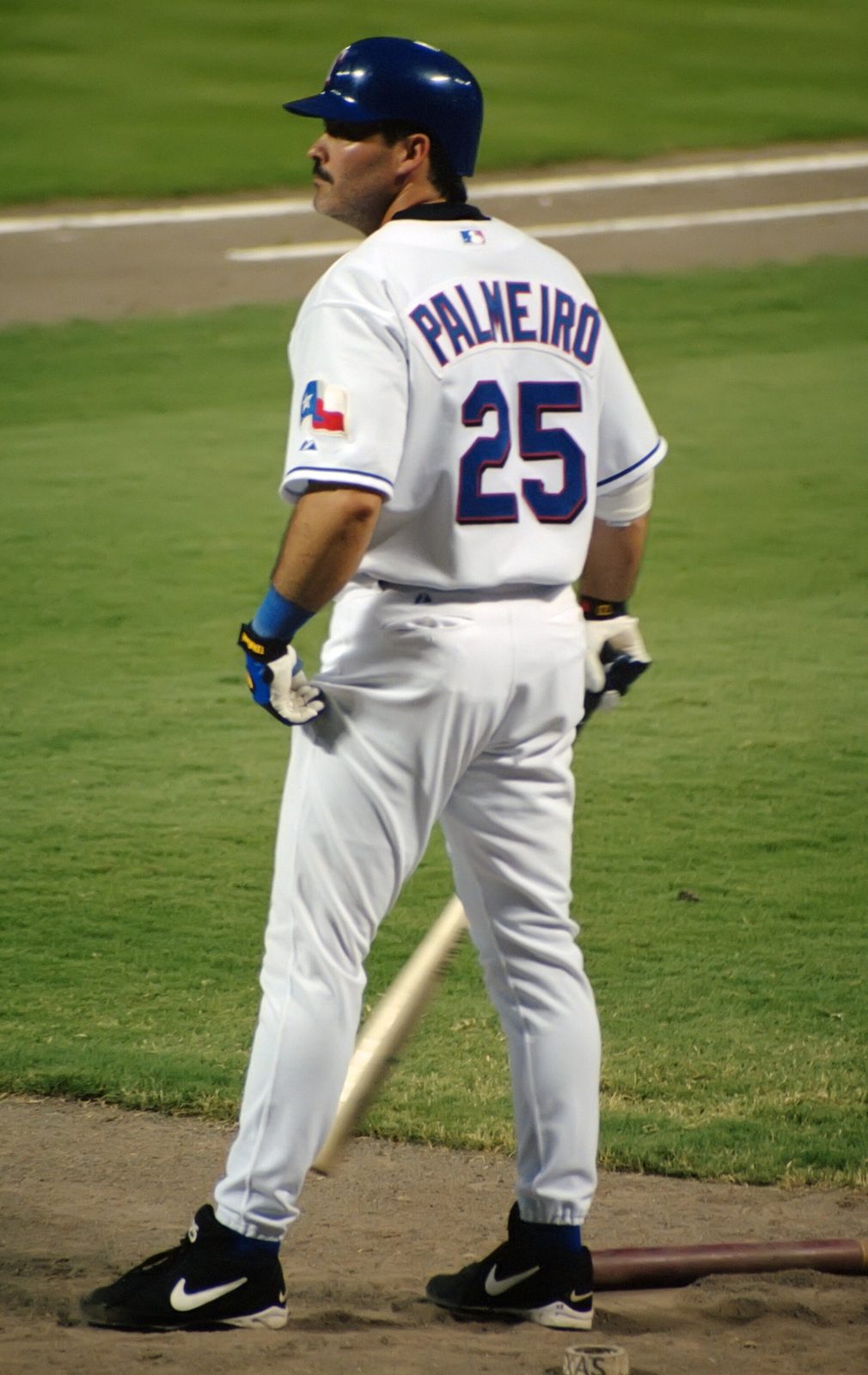
The Numbers: 3,020 Hits, 569 Home Runs
Rafael Palmeiro Corrales was born September 24, 1964, in Havana, Cuba, and became one of the most productive hitters of his generation. An All-American at Mississippi State University, he was drafted by the Chicago Cubs in 1985 and debuted in 1986. Over 20 seasons with the Cubs (1986-1988), Texas Rangers (1989-1993 and 1999-2003), and Baltimore Orioles (1994-1998 and 2004-2005), he compiled a .288 batting average with 3,020 hits, 569 home runs, and 1,835 RBIs. He was a four-time All-Star (1988, 1991, 1998, 1999), a three-time Gold Glove winner (1997-1999), and a two-time Silver Slugger (1998, 1999). From 1999 to 2003 he averaged 41 home runs and 121 RBIs per season - a model of elite consistency. On May 11, 2003, he hit his 500th home run. On July 15, 2005, he doubled off Seattle pitching for his 3,000th hit, becoming the 23rd member of the 3,000-hit club and one of only seven players ever to reach both 3,000 hits and 500 home runs. By every statistical measure, Rafael Palmeiro was a lock for the Hall of Fame. Then, 17 days after the milestone, everything collapsed.
The Finger Wag: 'I Have Never Used Steroids. Period.'
The moment that defines Rafael Palmeiro's legacy happened on March 17, 2005, in a congressional hearing room. Called before the House Government Reform Committee alongside Mark McGwire, Sammy Sosa, and Jose Canseco to testify about steroids in baseball, Palmeiro looked straight into the cameras, wagged his right index finger at the committee, and delivered the most famous denial in sports history: 'Let me start by telling you this: I have never used steroids. Period.' The line was electric - definitive, defiant, and, as the world would learn within months, false. At the time, Palmeiro was coming off a strong 2004 season and closing in on 3,000 hits; the testimony was meant to cement his reputation as the clean star of the steroid era. Instead it became the setup for one of the most dramatic falls in baseball history. The finger wag is now shorthand for every hollow denial in sports - replayed endlessly, memed relentlessly, and permanently attached to Palmeiro's name. He would later suggest, in a 2023 podcast appearance, that MLB may have 'sabotaged' him by altering his test results - a claim no evidence has ever supported.
The 3,000th Hit: July 15, 2005
The 3,000th hit itself was a moment of pure triumph. On July 15, 2005, in Seattle, Palmeiro drilled a fifth-inning RBI double in a 6-3 Orioles victory, becoming the 23rd member of baseball's most exclusive fraternity. His teammates mobbed him; the milestone seemed to validate everything - the consistency, the longevity, the clean image he had just defended before Congress. He was 40 years old, in the twilight of a magnificent career, and the narrative was set: the dignified veteran riding into the sunset with his milestones intact. What no one knew was that the test that would end his career had already been administered. Palmeiro had tested positive for stanozolol, an anabolic steroid, and the suspension was coming. The celebration of the 3,000th hit now reads as the last happy chapter of a career about to be consumed by scandal - a milestone that should have been the crowning achievement, permanently footnoted by what followed 17 days later.
The Failed Test: A 10-Game Suspension
On August 1, 2005, Major League Baseball announced that Rafael Palmeiro had tested positive for an anabolic steroid and suspended him for 10 games - making him the biggest star ever suspended under the sport's new drug policy. The fallout was immediate and total. Every outlet in the country led with the story; the contrast with the March finger-wag was irresistible and devastating. Palmeiro's explanation was that the positive test came from a tainted vitamin supplement given to him by a teammate - he named no names publicly at the time, denied any intentional steroid use, and appealed the suspension. The appeal was denied. The tainted-supplement defense convinced almost no one: it became the template excuse of the steroid era, and the finger-wagging video made it impossible to take seriously. Teammates were blindsided; fans were furious. When the suspension ended, Palmeiro returned to Baltimore for what was supposed to be 'Rafael Palmeiro Appreciation Day' and was greeted by a mix of boos and scattered cheers. He went 2-for-26 in a shell-shocked slump. The career was over in everything but name.
The End: Sent Home in September
The final act was as unceremonious as the milestones had been glorious. After returning from suspension on August 14, Palmeiro played his last major-league game on August 30, 2005. In September, citing a combination of knee and ankle injuries - and, by wide acknowledgment, the fan backlash - the Orioles advised him to take the rest of the season off. He collected his belongings without a word to his teammates and flew home. 'That's how it ended - no announcement, no celebration,' he later said. 'That was my retirement. I got sent home.' He tried to stay in shape hoping for an offer in 2006, but no team would take a flyer on a 40-year-old with a steroid past, and when his agent stopped calling, the reality set in. He retreated to his Dallas-area estate. The man who had been a model of consistency for two decades - 2,831 games played, 3,020 hits, 569 home runs - was done, not with a farewell tour but with a quiet flight to Teterboro, New Jersey, the day the suspension was announced. Baseball had rarely seen a fall so fast or so complete.
The Hall of Fame Fallout
The steroid suspension did exactly what Palmeiro feared it would: it locked the Hall of Fame door. Despite statistics that dwarf many Cooperstown inductees, he received just 11 percent of the writers' vote in his first year of eligibility and fell off the ballot entirely in 2014. He became the first player ever suspended for failing a steroid test to appear on an era-committee ballot - a groundbreaking and, for the committees, uncomfortable test case - but the Hall of Famers on those committees have shown no inclination to let him in. The 3,000/500 club, once a golden ticket, became a cautionary exhibit: of the seven members, the steroid-tainted ones are the ones outside looking in. Palmeiro's case is the starkest because of the finger wag - the lie told to Congress on camera, under oath, months before the positive test. Voters have treated it as disqualifying in a way that mere suspicion was not. He was inducted into the Mississippi State Athletic Hall of Fame (2008) and the College Baseball Hall of Fame (2009), small consolations for a man whose numbers say Cooperstown and whose biography says otherwise.
Where Is Rafael Palmeiro Now? (October 2026)
As of October 2026, Rafael Palmeiro lives quietly in the Dallas suburbs, largely disconnected from professional baseball. By his own account, his days are simple: 'Not a whole lot. I play a little golf.' His youngest son, Preston, played in the Los Angeles Angels' minor-league system, and Palmeiro has spent time watching and working with him - the closest he has come to the game in two decades. He has said he would love to get back into baseball in some capacity, but at 61, with the steroid stigma undiminished, no door has opened. He is not involved in coaching, broadcasting, or front-office work; he is not a regular at old-timers' games. The occasional podcast appearance - like his 2023 turn on 'Abriendo El Podcast,' where he floated the sabotage theory - is the extent of his public profile. The man who once wagged his finger at Congress now keeps his head down. What happened to Rafael Palmeiro is a tragedy in the classical sense: a great career destroyed not by failure but by a lie, told on television, about the one thing that mattered.
The Legacy: Greatness and the Asterisk
How should baseball remember Rafael Palmeiro? The numbers are beyond dispute: 3,020 hits (26th all-time), 569 home runs (14th all-time), 1,835 RBIs, a .288 average over 20 seasons, and membership in the most exclusive statistical club in the sport. Only six other players have 3,000 hits and 500 home runs. By production alone, he is one of the greatest hitters who ever lived - a left-handed-hitting first baseman whose consistency from 1988 through 2004 was the envy of the league. But the asterisk is equally beyond dispute. The finger wag, the failed test, the tainted-vitamin excuse, the sabotage theory - the whole arc has made him the face of the steroid era's dishonesty in a way that even admitted users have escaped. Palmeiro's story is taught now as a warning: about pride, about the cameras, about the moment when a man's public denial becomes his epitaph. The hits are in the books. The rest, as he himself said, they can take away.
Frequently asked questions
Why was Rafael Palmeiro suspended?
In August 2005, Palmeiro tested positive for stanozolol, an anabolic steroid, and received a 10-game suspension under MLB's drug policy - making him the biggest star suspended under the new rules. The suspension came just 17 days after his 3,000th hit and five months after he wagged his finger at Congress and said, 'I have never used steroids. Period.' His appeal was denied.
Did Rafael Palmeiro admit to using steroids?
No. Palmeiro has consistently denied intentional steroid use. He claimed the positive test resulted from a tainted vitamin supplement given to him by a teammate. In a 2023 podcast appearance, he went further, suggesting MLB may have 'sabotaged' his Hall of Fame case by altering his test results - a claim no evidence has supported.
Why isn't Rafael Palmeiro in the Hall of Fame?
The steroid suspension destroyed his candidacy. Despite 3,020 hits and 569 home runs, he got only 11 percent of the writers' vote in his first year of eligibility and fell off the ballot in 2014. He has since appeared on era-committee ballots - the first player suspended for a failed steroid test to do so - but the committees have not elected him.
What is Rafael Palmeiro doing now?
As of October 2026, Palmeiro lives in the Dallas suburbs. He plays golf, is not involved in professional baseball, and has spent time watching his son Preston's minor-league career in the Angels' system. He has said he would like to return to baseball in some capacity, but no opportunity has materialized.
What was the finger-wagging incident?
On March 17, 2005, testifying before the House Government Reform Committee about steroids in baseball, Palmeiro wagged his right index finger at the committee and declared, 'I have never used steroids. Period.' Five months later he failed a steroid test. The clip became one of the most replayed moments in sports history and shorthand for a hollow denial.
How many players have 3,000 hits and 500 home runs?
Only seven players in MLB history are members of both the 3,000-hit club and the 500-home-run club. Palmeiro joined the group with his 3,000th hit on July 15, 2005 (his 500th homer had come on May 11, 2003). The exclusivity of the club is part of why his Hall of Fame exclusion is so striking.
When did Rafael Palmeiro retire?
His final game was August 30, 2005, for the Baltimore Orioles. In September 2005 the Orioles advised him to sit out the rest of the season, and no team signed him for 2006. He later described it: 'That's how it ended - no announcement, no celebration. That was my retirement. I got sent home.'
Where is Rafael Palmeiro from?
Palmeiro was born September 24, 1964, in Havana, Cuba. He became a U.S. citizen and starred at Mississippi State University, where he was an All-American before the Chicago Cubs drafted him in 1985. He was inducted into the Mississippi State Athletic Hall of Fame in 2008.
Sources
- Rafael Palmeiro - WikipediaWikipedia
- Rafael Palmeiro - The Baseball ScholarThe Baseball Scholar
- Rafael Palmeiro Opens Up About His Steroid-Tainted LegacyB'More Sports Nest
- Former All-Star Slugger Believes MLB Sabotaged His Hall of Fame EntryAlbat