What Happened to Elizabeth Montgomery?
Hollywood Royalty from Los Angeles
Elizabeth Victoria Montgomery was born on April 15, 1933, in Los Angeles, California, into a family where acting was not a dream but a trade. Her father was Robert Montgomery, a major film star and later a television producer and director, and her mother was stage and screen actress Elizabeth Bryan Allen, so Montgomery grew up inside the business, watching her parents work and learning, early, that fame was a job with hours and hazards. She began her career in the 1950s with a role on her father's television series, Robert Montgomery Presents, and she won a Theatre World Award for her Broadway debut in Late Love in 1956, a serious stage credential for a young actress who could easily have coasted on her family name. She did not coast. She worked, in television dramas and anthologies, building a reputation as a capable, intelligent performer with a gift for both comedy and drama.
Montgomery's early television work included appearances on Alfred Hitchcock Presents, The Loretta Young Show, The Untouchables and The Twilight Zone, and she earned her first Emmy nomination for playing Rusty Heller in an episode of The Untouchables in 1960, as a nightclub performer caught in a criminal world. The nomination announced her as a dramatic actress of real standing, and it came before the role that would define her public life. She was, by the early 1960s, a working actress with a famous father, a stage award and an Emmy nomination, waiting for the part that would make her a household name. It arrived in 1964, in the form of a witch.
Samantha Stephens, 1964 to 1972
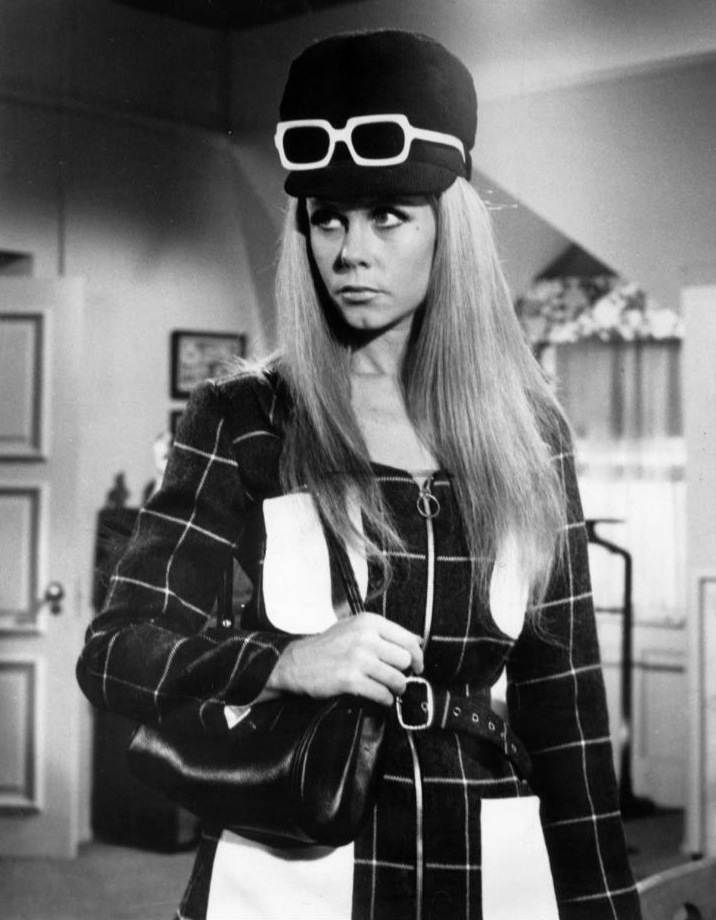
Bewitched premiered on ABC in 1964, and Montgomery played Samantha Stephens, a witch who marries a mortal advertising executive, Darrin Stephens, played first by Dick York and later by Dick Sargent, and who promises to give up magic for a normal suburban life, a promise she breaks, delightfully, in every episode. The show ran for eight seasons, from 1964 to 1972, and it became one of the great sitcoms of its era, a fantasy about marriage, in-laws and the impossibility of being ordinary, with Montgomery's nose twitch, her warmth and her comic timing at its center. She received five Emmy nominations and four Golden Globe nominations for the role, and Samantha became, for millions of viewers, the defining witch in American popular culture, a good witch whose powers were less interesting than her patience, her humor and her love for a mortal husband who could never quite keep up with her.
The show's success was also, in its way, a cage. Montgomery was Samantha to the public, and the public had trouble imagining her as anyone else, a problem she understood and set out to solve after the show ended. She had played Samantha for eight years, through two Darrins, through pregnancies written into the show and through the series' slow decline, and she had done it with a professionalism that never flagged. But she had also, during those years, married the show's producer and director, William Asher, had three children, and built a life that was, off camera, far more complicated than Samantha's. When Bewitched ended in 1972, Montgomery did not look for another sitcom. She looked for roles that would prove Samantha was only one of the women she could play.
A Case of Rape and Lizzie Borden
Montgomery's post-Bewitched career was a deliberate act of reinvention, and its centerpieces were two television films that no one who knew her only as Samantha could have predicted. In A Case of Rape in 1974 she played a woman who reports a rape and then faces a legal system that puts her, rather than her attacker, on trial, a serious, harrowing performance that earned her an additional Emmy nomination and that announced, unmistakably, that the witch was gone. In The Legend of Lizzie Borden in 1975 she played Lizzie Borden, the Massachusetts woman acquitted of murdering her father and stepmother with an axe in 1892, a role that required her to be chilling, ambiguous and utterly unlike Samantha, and that earned her another Emmy nomination. The two films together form one of the boldest second acts in television history, and they remain the performances, after Bewitched, for which Montgomery is most respected.
She continued to work in television films through the 1970s, 1980s and 1990s, playing detectives, victims, mothers and murderers, and she returned to Broadway one last time in 1989, in a production of Love Letters opposite Robert Foxworth, the actor who would become her fourth husband. She was also, throughout her career, a political activist, involved in women's rights, gay rights and AIDS activism, volunteering with AIDS Project Los Angeles and amfAR at the height of the AIDS epidemic, and working with the Los Angeles unit of Learning Ally, which records educational audiobooks for people with disabilities. The activism was not a late-career hobby. It was, by every account, central to who she was, a woman who used her fame for causes she believed in, quietly and consistently, for decades.
Four Marriages and Three Children
Montgomery married four times. Her first marriage, to New York socialite Frederick Gallatin Cammann in 1954, ended in divorce within a year. Her second, to actor Gig Young from 1956 to 1963, ended as Young's drinking and volatility made the marriage untenable. Her third, to director and producer William Asher from 1963 to 1973, was the marriage that made Bewitched: Asher produced and directed the show, Montgomery starred in it, and together they had three children, William Asher Jr., born in 1964, Robert Asher, born in 1965, and Rebecca Asher, born in 1969. The marriage ended in divorce in 1973, a year after the show ended, closing both the professional and the personal partnership that had defined her thirties.
Her fourth marriage was the longest relationship of her life, even though the wedding came late. She met actor Robert Foxworth while filming Mrs. Sundance, and the two lived together for nearly twenty years before marrying on January 28, 1993, remaining married until her death. Foxworth was with her at the end, along with her three children, and he read sympathy cards from fans at her memorial service, a measure of how deeply the public had taken her into its life. Montgomery also became, after her death, the subject of a genealogical curiosity: research revealed that she and Lizzie Borden, the woman she had played in 1975, were sixth cousins once removed, both descended from a seventeenth-century Massachusetts resident named John Luther, a coincidence that delighted fans of both the actress and the legend.
The Edna Buchanan Films and the Final Role
Montgomery's last television series was a pair of detective films based on the work of Miami journalist Edna Buchanan, in which she played a crime reporter navigating a world of murder and corruption. The second and final film of the series received its first airing on May 9, 1995, only nine days before Montgomery died, a timing that gave her final performance an unintended poignancy. She had filmed Deadline for Murder: From the Files of Edna Buchanan in late March 1995, ignoring influenza-like symptoms that she attributed to overwork and the flu, and by the time the cancer was diagnosed, it had spread beyond treatment. Her final work to be screened, a voice role as a barmaid in an episode of Batman: The Animated Series called Showdown, aired posthumously, a small, strange coda to a career that had begun on her father's television show forty years earlier.
Montgomery had, by several accounts, believed for years that she had beaten colon cancer once before, which may explain why she ignored the symptoms during filming, and why the diagnosis, when it came in the spring of 1995, was such a shock. She chose, with no hope of recovery, to return to the Beverly Hills home she shared with Foxworth rather than die in a hospital, and she died there on the morning of May 18, 1995, at sixty-two, surrounded by Foxworth and her three children. Her body was cremated, she had no funeral, and a memorial service was held on June 18, 1995, at the Canon Theatre in Beverly Hills, where speakers included her husband, her brother, her daughter and her nurse, and where jazz musician Herbie Hancock performed.
Illness, Death and the Age Question
Montgomery's death was reported at the time with a curious discrepancy that has followed her ever since: her family told the Los Angeles Times she was fifty-seven, while her birth year of 1933 made her sixty-two, a gap that fed rumors she had shaved years off her age, as many actresses of her generation did. This article uses sixty-two, the age that follows from her widely documented birth date of April 15, 1933, and notes the family quote only as a variant, not as a competing fact. The discrepancy does not change the story: a woman who had been famous for more than forty years died at home, eight weeks after a diagnosis that came too late, after a career that had taken her from her father's television show to Broadway to eight seasons as America's favorite witch to two of the bravest television films of the 1970s.
What is not in dispute is the speed of the end. In March 1995 Montgomery was filming, feeling ill, attributing her fatigue to influenza and overwork. By April she had undergone surgery to remove a small malignant tumor and had been told the cancer was stage four. By May 18 she was gone. The swiftness shocked fans who had grown up with Samantha, and it gave her final Edna Buchanan film, aired nine days before her death, the quality of a farewell she had not known she was giving. She had spent her career playing women who survived impossible situations, and in the end she faced one she could not survive, with the same privacy and dignity she had brought to everything else.
What Happened to Elizabeth Montgomery, in the End
So what happened to Elizabeth Montgomery? She became Samantha Stephens, she outgrew Samantha Stephens, and she spent the last twenty years of her life proving, film by film, that the witch had been only the beginning. She was a Broadway actress, an Emmy-nominated dramatic performer, a sitcom star, a Lizzie Borden, a rape victim demanding justice on screen, an activist for women's rights and AIDS patients, a mother of three and a wife of four marriages, the last of which lasted, in all but name, for more than twenty years. She died on May 18, 1995, at her Beverly Hills home at sixty-two, of colorectal cancer, eight weeks after diagnosis, surrounded by her husband and her children, and she was cremated, without a funeral, as she had wished.
What remains is the nose twitch, still imitated by fans, still instantly recognizable, and the two television films that proved she was far more than a sitcom witch, and the activism that outlived her, and the strange, perfect coincidence that the woman who played Lizzie Borden turned out to be Lizzie Borden's distant cousin. Montgomery was, to the end, exactly what Bewitched had promised and what her later career had proved: a woman of magic, in the sense that matters, the kind that comes from talent, from courage and from refusing to be only one thing.
Frequently asked questions
What happened to Elizabeth Montgomery?
Elizabeth Montgomery died on May 18, 1995, at her Beverly Hills home at 62, of colorectal cancer diagnosed eight weeks earlier. She had played Samantha Stephens on Bewitched and later starred in serious television films.
Who did Elizabeth Montgomery play on Bewitched?
Samantha Stephens, a witch married to mortal Darrin Stephens, from 1964 to 1972, for eight seasons. She earned five Emmy nominations and four Golden Globe nominations for the role.
What were Elizabeth Montgomery's best roles after Bewitched?
A Case of Rape (1974), in which she played a rape victim facing a hostile legal system, and The Legend of Lizzie Borden (1975), in which she played Lizzie Borden. Both earned her additional Emmy nominations.
How many times was Elizabeth Montgomery married?
Four times: Frederick Gallatin Cammann (1954-1955), Gig Young (1956-1963), William Asher (1963-1973) and Robert Foxworth (1993 until her death). She had three children with Asher.
How did Elizabeth Montgomery die?
Of colorectal cancer that had spread to her liver. She ignored flu-like symptoms while filming in March 1995, was diagnosed in the spring, and died at home on May 18, 1995, eight weeks later.
Was Elizabeth Montgomery related to Lizzie Borden?
Genealogical research after her death found that Montgomery and Lizzie Borden were sixth cousins once removed, both descended from seventeenth-century Massachusetts resident John Luther.
What was Elizabeth Montgomery's last role?
Her last television series was the Edna Buchanan detective films; the second film aired May 9, 1995, nine days before her death. A voice role on Batman: The Animated Series aired posthumously.
How old was Elizabeth Montgomery when she died?
Sixty-two, per her birth date of April 15, 1933. Her family told the Los Angeles Times she was 57 at her death, a variant this article does not use.
Sources
- EN WikipediaBirth, Bewitched run, five Emmy nominations, marriages, children, death May 18, 1995
- Television AcademyBewitched star, death from colorectal cancer, over 200 roles, Lizzie Borden film
- SurvivorNetDeath May 18, 1995, at 62, colorectal cancer, husband Robert Foxworth, three children