What Happened to Cammie King?
Chosen From 250 Applicants
Eleanore Cammack King was born on August 5, 1934, in Los Angeles, to W. Cammack King, a chemical plant manager, and Eleanore King, a schoolteacher. Her older sister Diane was already a child actress, and it was Diane who, indirectly, launched Cammie's career. When casting began for the role of Bonnie Blue Butler, the daughter of Rhett Butler and Scarlett O'Hara in Gone With the Wind, 250 applicants were tested, including seven-year-old Diane, who was deemed too old for the part. Diane told the casting staff that her four-year-old sister looked like her and could read lines, and that tip changed film history. Cammie was tested, and she got the part.
The casting story captures something essential about Gone With the Wind: it was a production so vast, and so obsessed with getting every detail right, that it tested hundreds of children for a role with only a few minutes of screen time. Bonnie Blue is not a large part, but she is a crucial one, the child whose birth redeems Rhett, whose love softens Scarlett, and whose death breaks Rhett's heart. The film needed a little girl who could carry that weight, and it found her in a four-year-old whose sister had vouched for her.
Bonnie Blue and the Death Mask
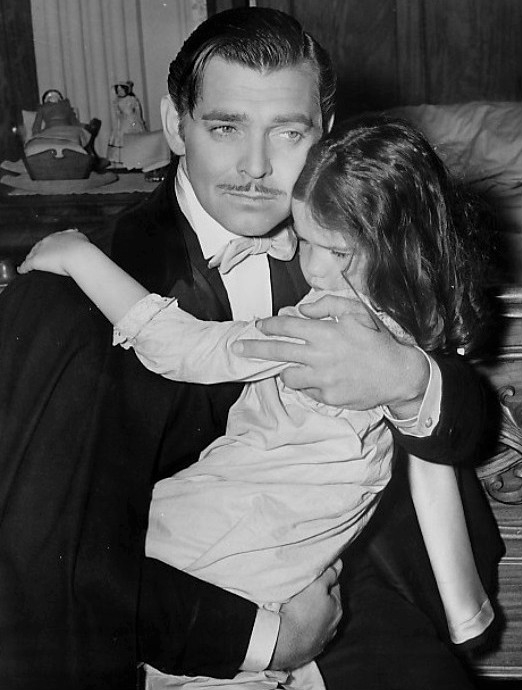
Cammie King played Bonnie Blue Butler in Gone With the Wind, released in 1939, and her performance, though brief, is one of the film's most remembered. Bonnie is the golden child of the Butler marriage, doted on by Rhett, played by Clark Gable, and the scenes between Gable and King have a tenderness that anchors the film's second half. King remembered her lines, but she could not keep her eyelids from moving during Bonnie's death scene, so she was fitted with a death mask, a practical solution that the production used to achieve the stillness the scene required. An adult male small person served as the body double for Bonnie's fall from her horse, the accident that kills her in the story.
King also appeared, uncredited, as Millie in Blondie Meets the Boss in 1939, but Bonnie Blue was the role that defined her, and she knew it. She later joked, I peaked at five, a line that is funny precisely because it is true, and because she said it with affection rather than bitterness. Most actors never get a role as famous as Bonnie Blue. King got hers before kindergarten, and she spent the rest of her life making peace with that fact, and then making a life beyond it.
Faline in Bambi and the Lost Role
King's second famous role was one audiences heard rather than saw. She voiced young Faline, the fawn who becomes Bambi's mate, in Disney's Bambi in 1942, uncredited. The Associated Press obituary calls Bambi her final film role, and in on-screen terms that is correct: she never appeared in another feature film. Wikipedia's filmography also lists a 2010 narration credit, Change in the Wind, which this article treats as a later narration credit rather than a return to screen acting. The distinction matters, because King's story is one of leaving film, not of lingering in it.
She might have had a third role in the early 1940s, but she lost it in the most childhood way imaginable: she broke out with chicken pox on the day filming began. The story, reported by the Los Angeles Times via Wikipedia, is a perfect emblem of her brief career: a little girl whose body, like any little girl's, got in the way of the studio's plans. After Bambi, the film roles stopped, and King grew up away from the cameras, a former child star at an age when most children are just starting school.
USC and a Start in Television
King's parents divorced a few years after Gone With the Wind, and in 1949 her mother married Herbert Kalmus, the co-founder of Technicolor, keeping the family connected to the film industry even as King's own acting career ended. King attended Marymount High School and then the University of Southern California, where she earned a bachelor's degree in communications in 1956. It was a deliberate, practical choice: a degree in the field that studies how messages travel, from a woman who had delivered one of the most famous messages in film history before she could tie her shoes.
After graduation, she worked as a production assistant on Climax!, a CBS television anthology series, a behind-the-scenes job that kept her in the industry without putting her in front of a camera. It was a brief foray, and it did not lead to a career in television production. Instead, it confirmed what King already seemed to know: her future lay outside show business, in work that used her communication skills in a different setting, far from Hollywood.
Forty Years on the Mendocino Coast
In 1980, King moved to Northern California, and there she built the career that would occupy the rest of her working life. She spent forty years in public relations and Chamber of Commerce work, including a long tenure as marketing coordinator for the Fort Bragg-Mendocino Coast Chamber of Commerce. Secondary reporting also describes her as director of the Kelly House museum and publicist for the Little River Inn, roles that fit the same pattern: a communicator, an organizer, and a public face for a small coastal community that valued her.
The move north was a complete reinvention, and it lasted longer than her film career by an order of magnitude. Forty years of Chamber work, against a film career that lasted, in on-screen terms, about three years. King did not trade on her fame in Fort Bragg, at least not at first. She worked, she organized, she promoted the coast, and she became a respected local figure in her own right, not merely as the woman who had once been Bonnie Blue. That is the harder achievement, and it is the one she spent most of her life building.
Two Marriages and a Family
King married twice. Her first husband was Walter Ned Pollock, whom she married in 1957; they adopted two children, Matthew and Katharine, and Pollock died of cancer in 1968, according to Wikipedia, though one secondary obituary gives 1965. Her second husband was Michael W. Conlon, whom she married in 1971; he adopted her two children, and they divorced in 1975. Her father-in-law through that marriage was Judd Conlon, the musical arranger for Disney films including Alice in Wonderland in 1951 and Peter Pan in 1953, a connection that kept King linked to Disney even in her private life.
Her children were central to her later years. Her son, Matthew Ned Conlon, was by her side when she died, and she was survived by her son and her daughter, Katie Conlon Byrne. The family story is one of adoption, remarriage, and resilience, the ordinary stuff of a long life, lived far from the cameras that had filmed her as a child. King raised her children, worked her job, and lived in Fort Bragg, and the fame of Bonnie Blue was something she carried lightly, not something she lived inside.
Memoir, Retrospectives and To Tell the Truth
In her later years, King embraced her film past on her own terms. She often appeared at retrospectives with surviving Gone With the Wind cast members, meeting fans who had loved Bonnie Blue since childhood, and she appeared as a contestant on To Tell the Truth, in the John O'Hurley version, in the early 2000s, a game-show appearance that played on the delightful absurdity of a former child star hiding in plain sight. In 2009 she privately published Bonnie Blue Butler: A Gone With the Wind Memoir, selling it directly to fans through appearances and the internet, bypassing traditional publishing entirely.
The memoir is a fitting final project: a book about a role she played at four, written by a woman in her seventies, sold hand to hand to the people who cared. It was not a bid for fame. It was a record, set down by the only person who could write it, and it gave fans something no studio archive could: Bonnie Blue's own account of being Bonnie Blue. King understood, by then, that her childhood role was not a burden to escape but a story to tell, and she told it herself.
Death in Fort Bragg and Legacy
Cammie King died on September 1, 2010, at her home in Fort Bragg, California, at the age of seventy-six, of lung cancer, with her son Matthew Ned Conlon by her side. She was buried at Holy Cross Cemetery in Culver City. One online obituary page carries a misdated header of May 26, 2010, in its crawl, but the death date of September 1, 2010, is confirmed by Wikipedia, the Los Angeles Times, and the Associated Press text itself, and this article uses September 1.
Her legacy is double, and both halves deserve remembering. As Bonnie Blue, she is part of the most successful film ever made, the little girl whose death breaks Rhett Butler's heart and whose memory haunts the film's ending. As Cammie King Conlon of Fort Bragg, she was a public-relations professional, a museum director, a mother, and a neighbor, who spent forty years promoting a stretch of California coast that had nothing to do with Tara. She peaked at five, as she joked, and then she lived another seventy-one years, which is a longer and richer story than any peak.
Frequently asked questions
What happened to Cammie King?
Cammie King died September 1, 2010, at her home in Fort Bragg, California, at age 76, of lung cancer. After playing Bonnie Blue Butler at age four, she left acting, earned a USC communications degree, and worked 40 years in public relations on the Mendocino Coast.
Who did Cammie King play in Gone With the Wind?
She played Bonnie Blue Butler, the daughter of Rhett Butler and Scarlett O'Hara, in the 1939 film, cast after 250 applicants were tested. Her older sister Diane, deemed too old at seven, had suggested her.
Was Cammie King in Bambi?
Yes. She voiced young Faline, the fawn, in Bambi (1942), uncredited. The AP obituary calls Bambi her final film role; a later 2010 narration credit, Change in the Wind, is listed separately.
Why did Cammie King leave acting?
Her film roles ended in childhood; a third early-1940s role was lost when she broke out with chicken pox on the day filming began. She went on to USC, graduating in communications in 1956, and built a career outside show business.
What did Cammie King do after Hollywood?
She worked as a production assistant on Climax!, then moved to Northern California in 1980 and spent 40 years in public relations, including as marketing coordinator for the Fort Bragg-Mendocino Coast Chamber of Commerce.
Who was Cammie King married to?
Walter Ned Pollock (married 1957, two adopted children Matthew and Katharine; he died of cancer in 1968 per Wikipedia) and Michael W. Conlon (married 1971, divorced 1975).
What book did Cammie King write?
Bonnie Blue Butler: A Gone With the Wind Memoir, privately published in 2009 and sold directly to fans via appearances and the internet.
Where is Cammie King buried?
Holy Cross Cemetery, Culver City. She died at home in Fort Bragg, with her son Matthew Ned Conlon by her side.
Sources
- EN WikipediaBiography, casting, marriages, PR career, death
- Associated PressObituary via Legacy.com: Bambi as final film role; death September 1, 2010, Fort Bragg, lung cancer
- Los Angeles TimesObituary: death, career, chicken-pox lost role, Fort Bragg life