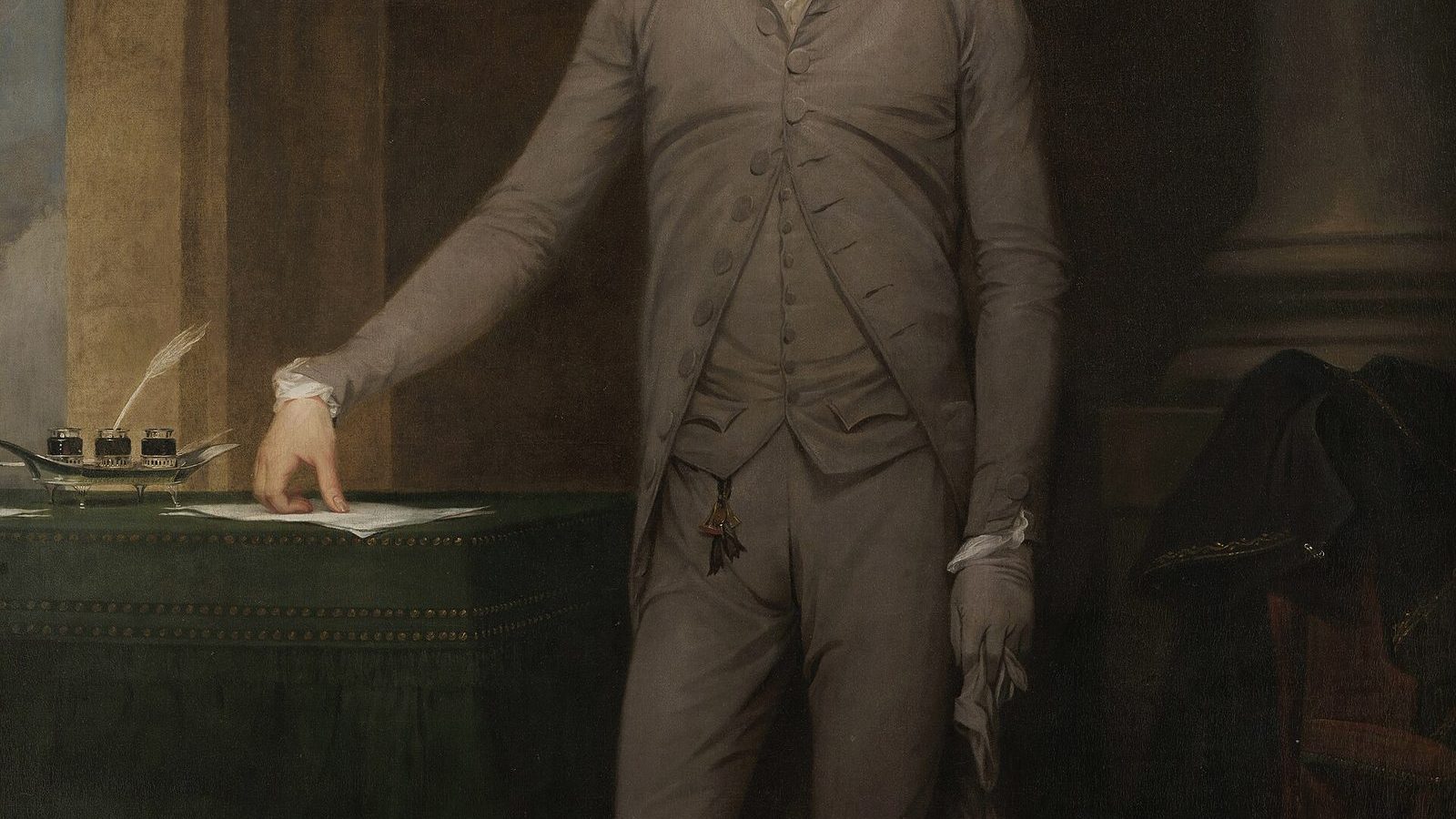
The Short Answer: 47 — or Possibly 49
Alexander Hamilton was 47 when he died, according to the birth year most historians now accept. But some records suggest he was actually 49. The confusion exists because Hamilton was born in the Caribbean, where 18th-century record-keeping was spotty, and because Hamilton himself gave different ages at different times — possibly to appear younger when seeking advancement as a young officer.
What is not in dispute is how he died: Hamilton was shot by Vice President Aaron Burr in a duel and died of his wounds the following day. The duel ended one of the most consequential lives in American history — a man who rose from an orphaned clerk on a Caribbean island to become George Washington’s right hand and the architect of America’s financial system.
Why Historians Can’t Agree on His Birth Year
Hamilton was born on the island of Nevis in the British West Indies, the illegitimate son of a Scottish trader and a French Huguenot mother. No baptismal record with a definitive year survives, and the two leading candidates differ by two full years.
Church and probate records point to the earlier year, which would make him 49 at death. But Hamilton himself, in his writings as a young man, implied the later year — possibly because claiming to be younger made his rapid rise look even more impressive, or simply because he genuinely didn’t know. Most modern biographers split the difference by noting both possibilities, which is why you’ll see his age at death given as “47 or 49” in careful accounts.
The irony is rich: the man who built America’s system of meticulous financial records left his own birthday a matter of scholarly debate.
The Duel With Aaron Burr
Hamilton’s death came at the end of a long, venomous rivalry with Aaron Burr, then the sitting Vice President of the United States. The two men’s hatred had been building for years — Hamilton had worked to deny Burr the presidency in a tied election and later helped block his bid for governor of New York, and Burr blamed Hamilton for destroying his political career.
After an exchange of insulting letters, Burr challenged Hamilton to a duel under the era’s code of honor. They met at dawn on the dueling grounds at Weehawken, New Jersey, across the Hudson from Manhattan — the same cliffs where Hamilton’s own eldest son had died in a duel a few years earlier. Burr’s shot struck Hamilton in the abdomen; Hamilton’s pistol discharged into the air. He was carried back across the river to a friend’s house in Manhattan, where he died the next afternoon surrounded by family.
Burr was charged with murder in two states but never tried; the duel effectively ended his political career too, making it a rare confrontation that destroyed both participants’ futures — one fatally, one politically.
What He Packed Into 47 Years
Hamilton’s résumé is staggering for a man who died in his forties. As a teenager he wrote a pamphlet defending the colonial cause that got him noticed; as a young artillery captain he so impressed George Washington that the general made him his aide-de-camp, essentially his chief of staff, for most of the Revolutionary War.
After the war, Hamilton became the driving force behind the Federalist Papers — the series of essays, written with James Madison and John Jay, that argued for ratifying the Constitution and remain the single most important commentary on what the document means. As the nation’s first Secretary of the Treasury, he created the financial architecture of the United States: a national bank, a system for managing Revolutionary War debt, and the customs and tax machinery that funded the young government.
He also founded the Federalist Party, America’s first political party, and the New York Post newspaper. Few figures in any era have shaped a country’s institutions so thoroughly before middle age.
His financial program was ferociously controversial in its day — Jefferson and Madison saw a national bank as a monarchical power grab — but it worked: American credit became the envy of the world, and the system he designed funded everything from westward expansion to industrialization. Modern economists still argue about him, which is more than most Treasury secretaries get.
Hamilton’s Wife and Children
Hamilton married Elizabeth Schuyler, daughter of the wealthy and powerful Schuyler family of New York, in a match that gave the Caribbean outsider entry into the colonial elite. Eliza, as she was known, outlived her husband by half a century, dying in her nineties — and she spent those decades fiercely defending his reputation, helping organize his papers and supporting the publication of his biography.
The couple had eight children, though not all survived to adulthood — a common tragedy of the era. Their eldest son, Philip, died in a duel at the very same Weehawken grounds where his father would later fall, a loss that devastated Hamilton. The surviving children scattered into law, the military, and public life, and Hamilton’s descendants remained prominent in American society for generations.
Eliza’s long widowhood is part of why Hamilton’s legacy survived: she made sure the world remembered the Treasury years, not just the duel.
Legacy: From Obscurity to Broadway
For much of American history, Hamilton was the Founding Father people half-remembered — his face on the ten-dollar bill, his name on a customs house. The duel with Burr tended to overshadow the Treasury achievements in popular memory, and his reputation suffered from the partisan battles of his own era.
That changed dramatically with the Broadway musical Hamilton, which turned his life into a cultural phenomenon and made his age at death — cut down in his forties at the height of his powers — feel like a personal loss to millions who sing his story. The show’s famous framing, that Hamilton was a young, hungry immigrant who wrote his way into history, recaptured something true about him even through its hip-hop gloss.
Today, historians rank him among the most consequential Treasury secretaries in American history, and the “47 or 49” footnote has become part of his mystique — the brilliant man who organized a nation’s finances but couldn’t quite pin down his own birthday.
Scholars continue to debate the might-have-beens: had he lived, would he have become president? Probably not — his foreign birth (under some readings of the Constitution) and his many enemies made the office a long shot. But as the man who designed the machine, he may have mattered more outside the presidency than he ever could have inside it.
Scandal: The Reynolds Affair
Hamilton’s career nearly ended long before the duel, thanks to America’s first great sex scandal: the Reynolds affair. Hamilton carried on an affair with a married woman, Maria Reynolds, whose husband then blackmailed him — paying hush money that his political enemies later spun as evidence of financial corruption.
Faced with rumors, Hamilton did something extraordinary: he published a pamphlet confessing to the affair in graphic detail to prove the payments were personal, not corrupt. It was a catastrophically honest move — it cleared him of corruption and destroyed his reputation for propriety in one stroke. Eliza, humiliated publicly, eventually forgave him; the political world never quite did.
The episode reveals the core Hamilton paradox: a man of almost pathological honesty about the wrong things, whose integrity about money coexisted with recklessness about everything else.
His Economic Vision, Still Running
Strip away the period costume and Hamilton’s program looks strikingly modern: a central bank to stabilize currency, federal assumption of state debts to build national credit, tariffs to protect infant industries, and a funded national debt as a engine of growth. It was, in essence, the playbook of the developmental state — two centuries early.
Every Treasury secretary since has operated in the building he designed. The national bank he chartered evolved into the modern Federal Reserve system; the creditworthiness he established let the young republic borrow cheaply for generations. When economists debate industrial policy today, they’re replaying the Hamilton-Jefferson argument with new vocabulary.
He died at 47 or 49 believing his enemies had won the narrative. They hadn’t — they were living inside his financial system the whole time.
Frequently Asked Questions
How old was Hamilton when he died?
Alexander Hamilton was 47 years old when he died, according to the most commonly accepted birth year — though some records suggest he may have been 49.
Why don’t historians agree on Hamilton’s age?
His Caribbean birth records are incomplete, and Hamilton himself gave inconsistent ages — possibly to seem younger. The two candidate birth years differ by two years.
How did Alexander Hamilton die?
He died from wounds suffered in a duel with Vice President Aaron Burr in Weehawken, New Jersey. Burr shot him; Hamilton died the following day.
Who was Aaron Burr?
Burr was the sitting Vice President of the United States and Hamilton’s longtime political rival. The duel ended Burr’s political career as well.
Was Hamilton married?
Yes. He married Elizabeth Schuyler, who outlived him by about fifty years and spent her widowhood defending his legacy.
How many children did Hamilton have?
Alexander and Eliza Hamilton had eight children, though not all survived to adulthood.
What is Hamilton famous for?
He was the first U.S. Secretary of the Treasury, co-authored the Federalist Papers, founded the Federalist Party, and designed America’s financial system.
Sources
- Wikipedia — Alexander HamiltonBiography, birth-year dispute, duel and death
- History.comFounding-era reference
- Founders Online (National Archives)Hamilton’s papers and correspondence