The Short Answer: 52 at His Death
Robert Norman Ross was 52 years old when he died. For over a decade, he hosted The Joy of Painting on PBS — thirty quiet minutes in which he’d conjure an entire mountain landscape from a blank canvas, narrating in a whisper-soft voice that made painting feel like meditation.
Ross died of lymphoma, a private battle he kept almost entirely out of the public eye — true to his gentle, unshowy nature. At the time, he was beloved but niche: a public-television fixture. In the decades since, he’s become something much bigger — an internet saint, a symbol of kindness, and one of the most memed humans who ever lived.
Before the Afro: Air Force and Alaska
Before the perm, Ross was a U.S. Air Force master sergeant stationed in Alaska — a drill-sergeant-adjacent role that required him to be, in his words, “tough” and loud. He has said he promised himself that if he ever left the military, he’d never raise his voice again — the origin story of the whisper.
Alaska’s snowy mountains, visible from his base, became the landscapes he’d paint for the rest of his life. He learned the wet-on-wet oil technique from a German painter, practiced obsessively, and began teaching — discovering he had a gift not just for painting but for making other people believe they could paint too.
The Joy of Painting: Happy Little Everything
The Joy of Painting ran on PBS for over a decade — hundreds of episodes, each a complete landscape in half an hour. The format never changed: Ross, palette in hand, talking viewers through every brushstroke in that hypnotic murmur. “We don’t make mistakes,” he’d say. “We just have happy accidents.”
The show’s philosophy was radical in its gentleness: art without judgment, creativity without gatekeeping. He painted for insomniacs, for stressed parents, for kids home sick — anyone who needed thirty minutes of calm. The perm, by the way, was a cost-saving measure he grew to dislike but kept because it’d become his logo.
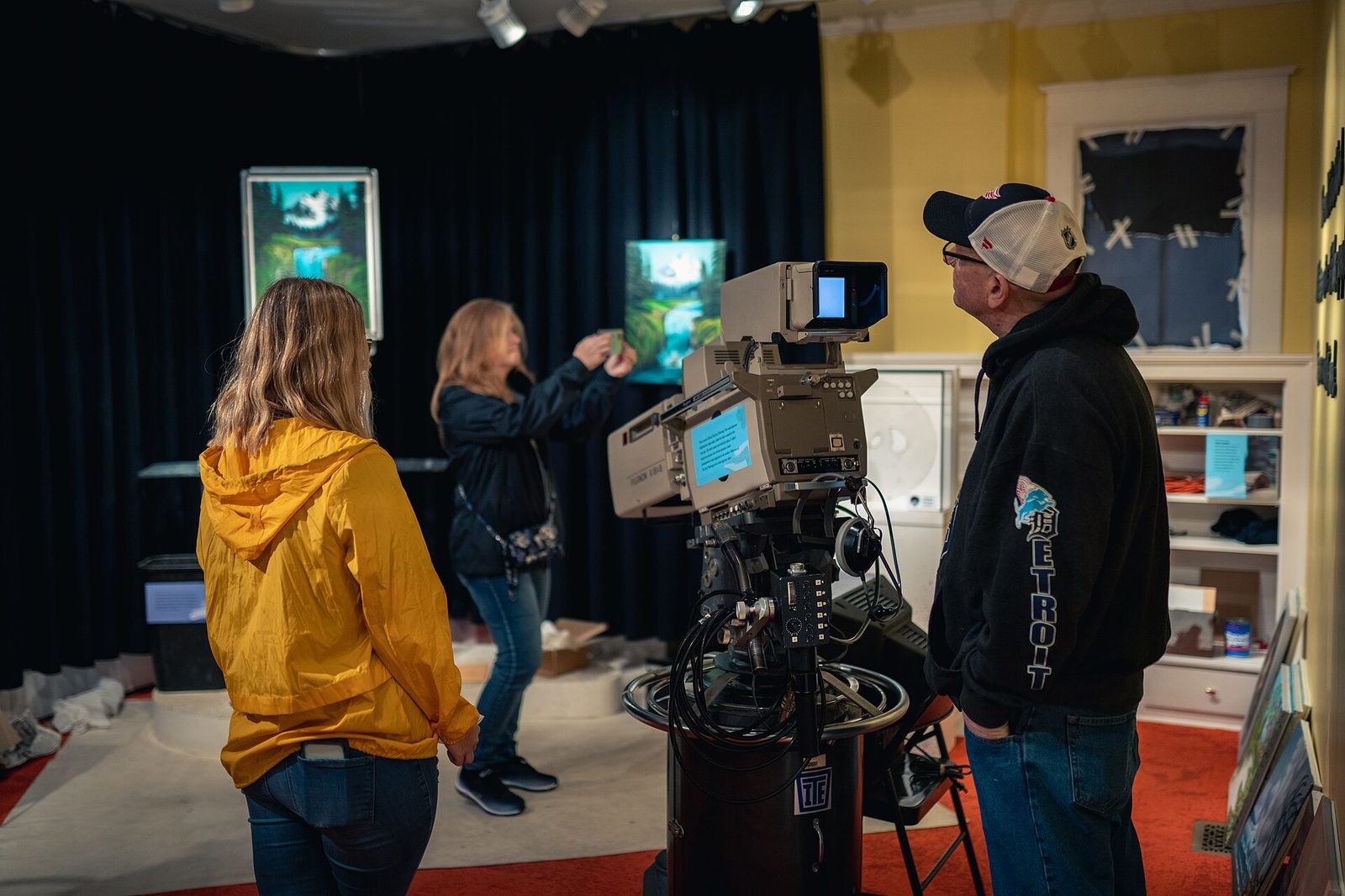
The show’s production was as humble as its host: a tiny studio, a single camera setup, Ross painting in real time with no edits. What you saw was what happened — including the occasional genuine mistake, which he’d seamlessly convert into a “happy accident” before your eyes.
Son Steve: The Heir to the Easel
Ross’s son, Steve Ross, is a painter in his own right who occasionally appeared on The Joy of Painting — a younger, chipper mirror of his father, wielding the same fan brush. Steve learned at his father’s side and inherited both the technique and the temperament.
After Bob’s death, Steve’s relationship with the Ross business empire became complicated — disputes over the rights to the Bob Ross name and image played out over years — but Steve has continued to teach and paint, carrying the family’s gentle artistic lineage forward. He remains the living link to the man behind the myth.
Marriages and Private Life
Ross was married three times and was intensely private about his personal life — a stark contrast to the intimacy of his on-screen persona. He kept his illness private too: most viewers had no idea he was sick until after his death, when the quiet man of public television was gone.
That privacy is part of why the mythology grew so clean — there were no scandals, no tell-alls, just the work. He was, by every account, exactly as kind off-camera as on: students describe a patient teacher who genuinely believed everyone could paint.
Legacy: The Internet’s Patron Saint
In death, Ross became exponentially more famous than in life. Streaming marathons of The Joy of Painting drew millions; his face launched a thousand memes; his quotes — “happy little trees,” “beat the devil out of it” (his brush-cleaning ritual) — entered the language. Twitch’s marathon of every episode was a cultural event.
But the deeper legacy is the philosophy: in an anxious age, Ross’s insistence that there are no mistakes — only happy accidents — reads like self-care before self-care existed. Art therapists cite him; stressed-out millions fall asleep to him. At 52, he left early — but he left behind the calmest half-hour in television history, on permanent loop.
His influence on art education is immeasurable: generations of painters started because a soft-spoken man on PBS made it look possible. “Talent is a pursued interest,” he’d say — and millions pursued it because he said so.
The Wet-on-Wet Technique
Ross’s signature method was alla prima — “wet-on-wet” oil painting, where layers are applied before the previous ones dry. The technique, which he learned from German painter Bill Alexander, is what made the thirty-minute landscape possible: no waiting, no underpainting marathons, just bold, immediate color.
He’d lay down a thin wash of “liquid white,” then build the entire scene — sky, mountains, trees, water — in a single flowing session. The fan brush, the palette knife, the big two-inch brush for skies: his tools were simple, his touch unmistakable. Students still learn “the Bob Ross method” as their first oil technique.
The genius was pedagogical: wet-on-wet forgives. A beginner’s shaky hand disappears into blended clouds; a misplaced tree becomes “a happy accident.” He engineered the technique of encouragement.
The Business of Happy Trees
Behind the gentle persona was a shrewd business: Bob Ross Inc., selling paints, brushes, how-to books, and instructional videos to the millions he inspired. The company — run with his business partners — turned the show’s goodwill into a durable empire that outlived him by decades.
The business side later became controversial: after Ross’s death, control of his name and image became the subject of bitter disputes, with his son Steve and former partners on opposite sides. A documentary laid bare the painful irony — the man who preached joy left behind a legal war over his legacy.
Through it all, the brand endured: the paints still sell, the videos still stream, and the happy little trees keep multiplying — a commercial afterlife as strange and sweet as the man himself.
Bob Ross Inc. — the company built on the whisper — became a licensing empire: the paints, the brushes, the branded everything. The business — run with the same gentleness as the show, at least in the telling — proved the philosophy scaled: kindness as commerce, the happy trees as trademark.
The Documentary Revelations
A documentary about Ross’s life and business pulled back the curtain on the quieter, more complicated man behind the whisper — the business battles, the family tensions, the partners who controlled the empire he built. For fans raised on the show’s gentleness, the revelations were jarring.
But the film’s deeper effect was to humanize him: the perfectionist who resented the perm, the businessman navigating partnerships, the father with complicated family dynamics. The saint became a person — flawed, funny, real.
And somehow the work survived the biography. The episodes still calm; the trees are still happy. Knowing the man was complicated only makes the gentleness he performed feel more deliberate — a choice, not an accident.
The Joy of Painting: The Enduring Legacy
The Joy of Painting — the half-hour of happy trees, beating the devil out of brushes, and “almighty” mountains — has outlived its creator by decades: the PBS reruns, the streaming marathons, the Twitch phenomena. Ross’s gentleness — the whisper, the encouragement, the “no mistakes, just happy accidents” — is antidote television for the anxious age.
The meme-ification — the costumes, the quotes, the Chia Pets — could have cheapened him; instead, it canonized: the internet’s patron saint of calm, the ASMR forefather, the proof that kindness scales. The parodies are love letters; the merchandise, devotion.
What endures — beyond the techniques, the landscapes, the afro — is the philosophy: everyone can paint, mistakes are just opportunities, the world is beautiful if you look. The happy trees were never the point; the permission to try was. Decades later, the whisper still works: believe you can, and you’re halfway there.
Frequently Asked Questions
How old was Bob Ross when he died?
Bob Ross was 52 years old when he died of lymphoma.
What show did Bob Ross host?
He hosted The Joy of Painting, a PBS instructional series where he painted a complete landscape in each half-hour episode.
Did Bob Ross have kids?
Yes — a son, Steve Ross, who is also a painter and appeared on his father’s show.
What does “happy little trees” mean?
It was Ross’s affectionate catchphrase for the trees he painted — and shorthand for his philosophy that art should be joyful and judgment-free.
Was Bob Ross in the military?
Yes. He was a U.S. Air Force master sergeant stationed in Alaska before becoming a painter — and he vowed never to raise his voice again after leaving.
Why did Bob Ross whisper?
His soft voice was deliberate — a reaction against his years as a loud military man, and central to the show’s calming effect.
What did Bob Ross die of?
He died of lymphoma, an illness he kept private during his final years.
Sources
- Wikipedia — Bob RossBiography, career, family, death
- Bob Ross (official)Official site and legacy
- PBSThe Joy of Painting broadcaster