Don King: Biography
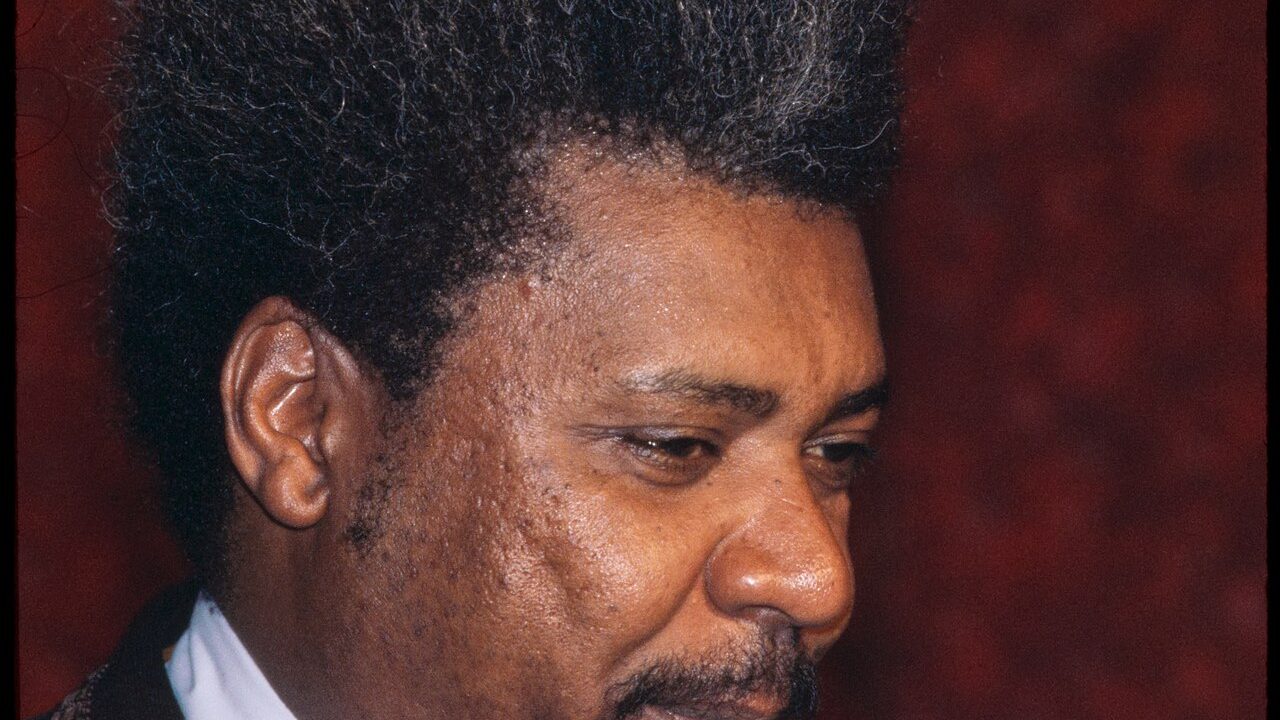
Quick Facts
- Born
- August 20, 1931
- Birthplace
- Cleveland, Ohio, U.S.
- Occupation
- American boxing promoter
- Years active
- 1952–present
- Spouse / Partner
- Not publicly disclosed
- Children
- 3
- Age
- 95 (as of 2026)
Who Is Don King?
Donald King (born August 20, 1931) is an American boxing promoter, known for his flamboyant and charismatic style, who was involved in some of the most famous boxing matches in history.
King's career highlights include, among multiple other enterprises, promoting "The Rumble in the Jungle" and the "Thrilla in Manila". King has promoted some of the most prominent names in boxing: Muhammad Ali, Joe Frazier, George Foreman, Larry Holmes, Tomasz Adamek, Roberto Duran, Mike Tyson, Evander Holyfield, Chris Byrd, John Ruiz, Julio César Chávez, Ricardo Mayorga, Bernard Hopkins, Félix Trinidad, Roy Jones Jr., Azumah Nelson, Chris Eubank, Gerald McClellan, Marco Antonio Barrera, Salvador Sanchez, Wilfred Benitez, Wilfredo Gomez and Christy Martin.
King is not without controversy as many of these same boxers sued him for allegedly defrauding them. Mike Tyson was quoted as saying, "He did more bad to black fighters than any white promoter ever in the history of boxing."
King has been charged with killing two people in incidents that were 13 years apart. In 1954, King shot a man in the back after spotting him trying to rob one of his gambling houses; this incident was ruled a justifiable homicide. Then, in 1967 King was convicted of second-degree murder for stomping one of his employees to death because he owed him $600. For this, he served three years and eleven months in prison, being released after the conviction was reduced on appeal to voluntary manslaughter.
Early life
King was born in Cleveland, Ohio, the fifth of six children to Clarence and Hattie King. Clarence worked at the Otis Steel plant owned by the Jones & Laughlin company and was killed in a workplace accident on December 7, 1941, when a ladle exploded and engulfed him in molten steel. Hattie received $10,000 (equivalent to $218,891 in 2025) in compensation and relocated the family to the middle-class Mount Pleasant neighborhood.
Early Life: Where Is Don King From?
His mother made a living selling peanuts and homemade pies, helped by King and his younger sister, and sold the wares at a local "policy house" that used the guise of a concession stand to run a numbers game. King and his older brothers eventually became involved in the betting scheme, with King later stating "So now what we did is we capitalized off of this here, and we hustled. It was statutorily illegal, but who knew about the statutes?" King graduated from John Adams High in 1951 and briefly attended Kent State University before dropping out.
Bookmaking and killings
Beginning in 1951, King ran an illegal bookmaking operation out of the basement of a record store on Kinsman Road, earning the byname "The Kid", as well as the nicknames "Kingpin" and "the Numbers Czar". During this time, King was charged with killing two men.
One of the incidents involved King killing an employee, 34-year-old Sam Garrett, in an open street in front of several witnesses, for owing $600 in debt. King beat and kicked Garrett and held a .357 magnum revolver to his head; Garrett never regained consciousness and died of severe head trauma on April 24. King claimed self-defense, while the prosecution, supported by witness testimony, including that of arresting police officer Bob Tonne, arguing that Garrett was attacked by King, with Garrett's last words being quoted as "Don, I'll pay you the money."
He was convicted of second-degree murder for the killing and sentenced to one-to-twenty years imprisonment. While he served his term at the Marion Correctional Institution, he began self-education; he read everything in the prison library he could get his hands on.
I learned this here, in the penitentiary, in reading everything that I can find my hands on, and then living the life that I live before I got to the penitentiary. That gave me an enlightenment on life that "don't get mad, get smart." That's why I want other kids to educate themselves, put it in their brain, they can't take that away.
Don King's Career and Major Works
In 1972, after serving three years and eleven months, King was released when his attorney got the conviction reduced to manslaughter. King was pardoned in 1983 by Ohio Governor Jim Rhodes, with letters written in support from Jesse Jackson, Coretta Scott King, George Voinovich, Art Modell, and Gabe Paul.
King entered the boxing world after persuading Muhammad Ali to box in a charity exhibition for a local hospital in Cleveland with the help of singer Lloyd Price. Early on, he formed a partnership with a local promoter named Don Elbaum, who already had a stable of fighters in Cleveland and years of experience in boxing.
In 1974, King negotiated to promote a heavyweight championship fight between Muhammad Ali and George Foreman in Zaire, popularly known as "The Rumble in the Jungle". The fight between Ali and Foreman was a much-anticipated event. King's rivals all sought to promote the bout, but King was able to secure the then-record $10 million purse through an arrangement with the government of Zaire.
King then went on to arrange Ali's 1975 fight against journeyman Chuck Wepner. It is widely believed that this fight inspired Sylvester Stallone to write the screenplay for Rocky (1976).
King solidified his position as one of boxing's preeminent promoters later that year by promoting the third fight between Ali and Joe Frazier in Manila, the capital of the Philippines, which King deemed the "Thrilla in Manila". Aside from promoting the premier heavyweight fights of the 1970s, King was also busy expanding his boxing empire.
Throughout the decade, he compiled an impressive roster of fighters, many of whom would finish their career with Hall of Fame credentials. Fighters like Larry Holmes, Wilfred Benítez, Roberto Durán, Salvador Sánchez, Wilfredo Gómez, and Alexis Argüello would all fight under the Don King Productions promotional banner in the 1970s.
Don King's Personal Life and Relationships
For the next two decades, King continued to be among boxing's most successful promoters. King would go on to promote boxing matches for Mike Tyson, Evander Holyfield, Julio César Chávez, Aaron Pryor, Bernard Hopkins, Ricardo López, Félix Trinidad, Terry Norris, Carlos Zárate, Azumah Nelson, Andrew Gołota, Mike McCallum, Gerald McClellan, Meldrick Taylor, Marco Antonio Barrera, Tomasz Adamek, John Ruiz, and Ricardo Mayorga among others.
King's promoting and interest was not confined to just boxing. He was the concert promoter for The Jacksons' 1984 Victory Tour. In 1998, King purchased a Cleveland-based weekly newspaper serving the African American community in Ohio, the Call and Post, and continues to serve as its publisher in 2026.
Among his many accomplishments, King was elected to the Gaming Hall of Fame in 2008.
In 2023, King was announced as the financier of the Bomaye Fight Club in Major League Wrestling.
As of 2024, King was still into promotions and was in talks with Canadian boxing promoter Dan Otter to stage a WBC cruiserweight world title bout later that year.
Personal life
Where Is Don King Now? Recent Years
Don King's wife, Henrietta, died on December 2, 2010, at the age of 87. They had one biological daughter, Debbie, a son, Eric and adopted son Carl, five grandchildren and three great-grandchildren.
King is also politically active; he supported Barack Obama in the 2008 and 2012 presidential elections. During the previous election, he had made media appearances promoting George W. Bush, which had included attendance at the 2004 Republican National Convention in New York City. He has also been a longtime supporter of Donald Trump.
On June 10, 1987, King was made a 'Mason-at-Sight' by "Grand Master" Odes J. Kyle Jr. of the Most Worshipful Prince Hall Grand Lodge of Ohio, thereby making him a Prince Hall Freemason. In the following year, he was awarded an honorary Doctorate of Humane letters degree from Central State University in Wilberforce, Ohio, by University President Dr. Arthur E. Thomas.
King has conducted an annual turkey giveaway each Christmas for several years, in which he distributes two thousand free turkeys to needy South Floridians.
In April 2016, the city of Cleveland named a section of Shaker Boulevard, located near King's Call and Post newspaper headquarters, the "Don King Way" in honor of King. In September 2016, the Cleveland City Council proposed that the name instead should be given to a road on Cedar Avenue. The proposal was controversial as Cedar Avenue was where King had killed Sam Garrett in 1966. The renaming was ultimately scrapped, but the boulevard section remains named after King.
In September 2024, King was hospitalized for an unspecified illness that required a blood transfusion. Widespread concern for King's health was prompted by a Mike Tyson media interview where he said, "You know, Don is not doing well right now. He's probably close to 100 years old. He's not doing well."
Don King's Legacy and Impact
Lawsuits and prosecutions
King has been investigated for possible connections with organized crime. On May 20, 1957, the porch of King's house was bombed and in October of the same year, King was shot in the head and neck with a shotgun by unidentified gunmen, reportedly due to his refusal to pay $200 in monthly protection money to crime boss Shondor Birns.
In December 1957, King's house was raided by the IRS for evasion of $32,029 (equivalent to $367,088 in 2025) in policy tax. Charges of blackmail against Birns and five others were ultimately dropped in July 1958 when King declined to testify in court. The attack on King's home eventually led to the landmark Supreme Court case Mapp v. Ohio.
At a 1992 Senate investigation, King invoked the Fifth Amendment when questioned about his connection to mobster John Gotti. When IBF president Robert W. Lee Sr. was indicted for racketeering in 1999, King was not indicted, nor did he testify at Lee's trial, though prosecutors reportedly "called him an unindicted co-conspirator who was the principal beneficiary of Lee's machinations."
King has been involved in many fraud litigation cases with boxers. In 1982, he was sued by Muhammad Ali for underpaying him $1.1 million for a fight with Larry Holmes. King called in an old friend of Ali, Jeremiah Shabazz, and handed him a suitcase containing $50,000 in cash and a letter ending Ali's lawsuit against King. He asked Shabazz to visit Ali (who was in the hospital due to his failing health), get him to sign the letter, and then give Ali the $50,000. Ali signed it. The letter even gave King the right to promote any future Ali fights. According to Shabazz, "Ali was ailing by then and mumbling a lot. I guess he needed the money." Shabazz later regretted helping King. Ali's lawyer cried when he learned that Ali had ended the lawsuit without telling him.
Boxing legend, Larry Holmes, has alleged that over the course of his career, King cheated him out of $10 million in fight purses, by claiming 25% of his purses as a hidden manager. Holmes says he received only $150,000 of a contracted $500,000 for his fight with Ken Norton, $50,000 of $200,000 for facing Earnie Shavers, and claims King cut his purses for bouts with Muhammad Ali, Randall "Tex" Cobb, and Leon Spinks, underpaying him $2 million, $700,000, and $250,000, respectively.
Holmes sued King over the accounting and auditing for the Gerry Cooney fight, charging that he was underpaid by $2 to $3 million. Holmes sued King after King deducted a $300,000 'finder's fee' from his fight purse against Mike Tyson; Holmes settled for $150,000 and also signed a legal agreement pledging not to give any more negative information about King to reporters.
Boxer Tim Witherspoon was threatened with being blackballed if he did not sign exclusive contracts with King and his stepson Carl. Not permitted to have his own lawyer present, he signed four "contracts of servitude" (according to Jack Newfield). One was an exclusive promotional contract with Don King, two were managerial contracts with Carl King, identical except one was "for show" that gave Carl King 33% of Witherspoon's purses and the other gave King a 50% share, more than is allowed by many boxing commissions. The fourth contract was completely blank.
Other examples include Witherspoon being promised $150,000 for his fight with Larry Holmes, but receiving only $52,750. King's son Carl took 50% of Witherspoon's purse, illegal under Nevada rules, and the WBC sanctioning fee was also deducted from his purse. He was forced to train at King's own training camp at Orwell, Ohio, instead of Ali's Deer Lake camp which Ali allowed Witherspoon to use for free. For his fight with Greg Page he received a net amount of $44,460 from his guaranteed purse of $250,000. King had deducted money for training expenses, sparring partners, fight and airplane tickets for his friends and family. Witherspoon was never paid a stipulated $100,000 for his training expenses and instead was billed $150 a day for using King's training camp. Carl King again received 50% of his purse, despite Don King Productions falsely claiming he had only been paid 33%. HBO paid King $1,700,000 for Witherspoon to fight Frank Bruno. Witherspoon got a purse of $500,000 but received only $90,000 after King's deductions. Carl King received $275,000. In 1987, Witherspoon sued King for $25 million in damages. He eventually settled for $1 million out of court.
Don King's career continues to be documented by reputable media; the facts above are drawn from Wikipedia's biography and public records.
Frequently asked questions
Who is Don King?
Donald King (born August 20, 1931) is an American boxing promoter, known for his flamboyant and charismatic style, who was involved in some of the most famous boxing matches in history.
How old is Don King?
Don King is 95 years old (born August 20, 1931).
Where is Don King from?
Cleveland, Ohio, U.S..
What is Don King known for?
American boxing promoter.
Is Don King married?
Relationship details, where confirmed, are covered in the personal-life section.
Does Don King have children?
3 — per public records.
What are Don King's major career highlights?
King is not without controversy as many of these same boxers sued him for allegedly defrauding them. Mike Tyson was quoted as saying, "He did more bad to black fighters than any white promoter ever in the history of boxing." King has been charged with killing two people in incidents that were 13 years apart. In 1954, King shot a man in the back after spotting him trying to rob one of his gambling houses; this incident was ruled a justifiable homi
Where can I find verified facts about Don King?
Wikipedia's biography, Britannica where available, and reputable entertainment media are the most reliable sources.